This year, I’ve decided to dedicate a portion of the proceeds of my annual calendar to the amazing research and conservation work Bring The Elephant Home is doing on elephant behaviour, habitat, and wellbeing in South Africa and Thailand (and soon other parts of Africa, like Zimbabwe, Uganda, and more!).
The calendars are available in my photography shop. Just select the SHOP button, go to Specialty Products, and scroll down to the calendars.
Currently, I’m only able to ship within the US, but send me a note if you’re out of the US and want a calendar…we’ll figure something out.
While you’re in my photography shop, browse around… you may find something fun as a holiday gift. The photo lab I use does amazing prints, and we can ship pretty quickly for holiday gifts.
What draws us to elephants is a mystery. Or is it? They represent wisdom and strength and empathy. They are revered in Thailand and in India and elsewhere in Asia. Ganesh is the Hindu elephant god of new beginnings, the remover of obstacles and bringer of wisdom and luck. His name in Thailand is Phra Phikanet.
Across Asia and Africa, these magical and mystical creatures are worshipped in temples and simultaneously loathed in the fields, where their land is being encroached upon by farms and development. A mere “drive by” by a herd can decimate a family’s crops in minutes.
I think I’ve always been charmed by the magic of elephants, intrigued by their human-like behaviours, disgusted by humans’ treatment of them and their habitat. My first visit to Africa gave me a up-close look into those long-eyelashed orbs and I was smitten. It’s not a secret that Ganesh is something of my patron saint, and it’s certainly no surprise that I’m something of a wildlife freak. So when an opportunity to participate in Bring the Elephant Home’s volunteer program, assisting scientists with crucial behavioral research to learn more about social structure, welfare and habitat usage, I couldn’t apply fast enough.
Fast-forward 8 or 9 months, and I’m beginning to pen this on my flight home, coming down from the elephant high that has been my status quo for the last couple of weeks.
I joined the group in Port Elizabeth (recently renamed to Gqeberha), on the Eastern Cape of South Africa: a couple from the UK, a handful of Californians, and a student studying ele behaviour at a University in Johannesburg. From PE, we went up to our post at the Kariega Conservation Center at the Kariega Game Reserve. I posted a blog at the beginning of our time there called What Happens When You Drop a Fence, outlining our initial observations and the main research objectives.
What was it like?
So the 8 of us volunteers, 2 PhD researchers, and a local ecologist ventured out into the thicket of Kariega Game Reserve each day looking for elephants. While like something out of a dream, it also felt much harder than it seemed like it should have been. One might think elephants are so big, and how could you miss them, right? Well, crazy ele fact #1: they move silently. I mean, so silently that you could be sitting in a spot for a while and see or hear nothing, but a moment later, you could glance over your shoulder and see an animal the size of a Land Cruiser standing just metres away, trunk curled, sniffing in your general direction. While you’d think they’d make themselves known by heavy footsteps, their massive feet are so cushioned that they walk as if clad in slippers. In fact, more often than not, we’d know they were nearby only from the branches snapping rather than anything else (the tracking collars, when working, didn’t hurt either 😉).
Day 1
That first afternoon we went out on a game drive to get our sea legs, as it were… we saw zebra and white rhinos and giraffes and warthogs (Pumba!) and of course a few elephants. Even though it was just a couple of hours on the reserve, and we got a flat tire just before dusk and had to wait a while for another vehicle to come and bring us a spare and a new jack, it didn’t feel like a harbinger of doom for the week. Instead, it felt like the beginning of a cool adventure. Especially when I looked up and realised that the giraffes we had been watching on the other side of a hill began to creep in closer to get a peek at what we were up to out there in the scrubby thicket.
The first full day was a series of lectures on why we were there, classes on how to do elephant identification, exercises in what to look for, behaviour-wise, and a slew of what to do when things around age and sex and different behaviours and dung sampling and using the Zoomonitor app to record said behaviours. It felt like a lot.
I mentioned to my manager that we had elephant school that first day. He replied that he had heard they are good learners. Us humans, though… the jury was still out.
One of the first lessons was ageing elephants. It’s done by relative size, facial features, and behavioral characteristics. Calves (<1) can walk underneath an adult cow. Juveniles (1-4) are still suckling but may or may not have tusk buds (squeee!!!). While Intermediates (5-8) may or may not look like sub-adults (9-15), they are weaned and the females take on more and more “big sister” duties. Sub-adult bulls spend less and less time in the center of the herd as they mature and become more independent (and, you know, more like naughty teenage boys!). Adults (15 and up) come in different shapes and sizes, depending on whether they are bull or cow. I learnt so much just this first day on these different stages, not least that bulls don’t even come into their first musth until they are about 25, while cows can start having their own calves by about 11.
Once we had a decent grasp on ageing, we moved on to sexing (size, head shape, body configuration, rear view). About half-way through this lesson I felt like I might fail elephant school altogether, so I was glad that the professionals would be with us in the vehicle to help out with our ID follies!
The team uses the SEEK (System for Elephant Ear Knowledge) system which incorporates a set of features and markings in addition to body condition on a scale from 1 (emaciated) to 5 (chubbo) to identify and code the targets of our observations. I’m grateful for the visual aids we were given, as well as the Elephant Voices ethogram website which we were encouraged to review prior to arriving. This was beginning to feel like work.
The last part of our training day was to review the different behaviours we were to observe and track: continuous behaviours like locomotion, grazing, browsing (and identifying the differences therein), and all-occurrence behaviours like head shake, sniff, play spar, trunk curl, trunk to face (and whose trunk to or from whose face)… again I was appreciative of the technology at hand – the app into which we were to record said behaviours and the myriad PowerPoint decks and references that had been prepared for us novices.
2 / 6
As the long day wound down, we received our marching orders: review the materials and get ready for an early wake up call. We were going into the field in the morning, then breaking up into groups of 3, one to observe behaviour, one to do elephant ID, and one to be the photographer.
One can only guess which role I was more than glad to take on.
Stay tuned for more adventures from a citizen-scientist perspective. And be sure to take a look at Bring the Elephant Home’s updates page for more stories from our time at Kariega.
THIS JUST IN: I just launched my new print store… take a look HERE. And use coupon code TGM-15 for a 15% site-wide discount!
The Maasai villages still operate much the same as they did hundreds of years ago. That is, they live in small compounds, with their animals, practicing rituals and ceremonies that have been handed down over generations.
After a performance of a traditional Maasai dance at our game lodge, I was walking back to my tent with one of the porters (it’s dark and there are critters around) and he asked me how I liked the show. “Did you see me jumping?” he asked. The lodge employs Maasai workers both as a contract with the tribe and to add cultural panache to the fancy digs. “It was great”, I replied, not recognising him in his uniform. “Jump highest and get a free lady,” he said with a humungous grin.
I had some understanding around the Maasai practices of arranged marriage and also polygamy, that the community has input into both, including negotiating the bride price. Wealth is measured in cows and wives here, after all. So I asked him whether he got a free lady. Beaming, he said, “Yes. I jump the highest. I’m going to get another one.” 💖
Maasai men demonstrating a ritual dance in one of their villages.
Welcome to the Maasai Mara. This park covers nearly 16002 km, roughly the size of London, which sounds actually smaller than it felt being there. The savannahs seemed to go on forever, or at least to Tanzania, where the Maasai Mara connects with the Serengeti to form an inter-national animal migration route. So once again I felt as though I were in a postcard rather than seated in a Land Cruiser in the southwestern part of Kenya making photos of the place.
The objective, apparently, in the Maasai Mara, is to find big cats. And while I liked seeing leopards and lions lounging in the sun, I honestly preferred the elephants grazing gracefully with their still-fuzzy calves. I preferred the zebras grazing amid the long grasses, the sun painting a glowing carpet. I preferred the giraffes, with necks so long they looked like they were floating along the savannah like giant puppets. I preferred the rhinos for their prehistoric and surreal stature; the rhinos curiously watching, with their notoriously terrible eyesight, the tourist-filled Land Cruisers, as if we were long-lost relatives.
And there were the hippos. If you guessed that these were the deadliest African beasts, you’d be correct! In fact, hippos kill 40 times more people per year than sharks (even coconuts kill more people every year than sharks, but that’s a completely different argument!). The sad truth, however, is that if you include all types of fauna, the deadliest animal in Africa is still the mosquito.
But I digress. Watching the hippos from the bush lodge in the Maasai Mara was a fantastic lunchtime activity. The word hippopotamus comes from the Greek word meaning river horses, presumably because they spend so much time in the water, protecting themselves from the sun. But upon hearing their clamour one afternoon, I have a different theory…
Before Mt. Kenya was called as such, the Kikuyu people called the it Kĩrĩma Kĩrĩnyaga, loosely translated to ‘the area of the ostrich’, for its black rock and snow-capped peaks that resembled the awkward bird’s plumage. Once the Colonists arrived and simplified (read: bungled) the name, the land (and Mountain) was christened as Kenya.
The last day in the Maasai Mara was elephants and ostriches and secretary birds and hornbills and other savannah oddities, plus trains of wildebeests and hartebeests and zebras, bringing up the rear end of the Great Migration towards the Serengeti. And as much as I’d like to post even more of the thousands of frames I shot, I’ll wrap up with a few more of my favourites.
So while I saw exactly zero glimpses of Mt. Kenya, I left the Rift Valley feeling like I had been squarely in the area of the ostrich for some time. I’ll end with another reading list to paint a more vivid picture of the country from several different perspectives:
Here I was, on a plane much larger than anticipated, flying over Lake Victoria from Kigali to Nairobi. It was like crossing a small ocean, a giant black hole in the night with a lot of unknowns waiting on the lake’s eastern shores. During the flight, I was piecing together in my brain what I thought I knew about Kenya and its history, but memories of the hordes of elephants I saw in Botswana, and the near-misses of them in Rwanda only gave me elephant dreams commingled with fuzzy expectations for the week ahead.
My thoughts, as I wended my way through immigration, then baggage, at Jomo Kenyatta International Airport, were that thankfully most airports everywhere function pretty much the same, whether in English or Swahili.
Truth be told, I prepared little for this trip. I signed up a mere 10 days before departure, visions of myriad wildlife and their Great Migration dancing in my head. I hastily arranged yellow fever and typhoid vaccines, solicited favors for airport runs and plant-sitting, packed, then departed, leaving my overwhelming reality behind if only for a couple of weeks. I hadn’t had time to consider the urban spaces dotting the beginning, middle and end of the adventure.
And so, landing in Nairobi was very different than arrival in Kigali. Nairobi is fairly large as cities go, with roughly the population of Sydney; 5x that of Kigali. The slick urban-ness of the place was a little jarring as we navigated through traffic from the airport into the city proper. Gone were the neatly cobbled streets and manicured roundabouts I’d come to adore in Rwanda. This was a City, and all vibes pointed to its wanting to be like New York or LA. Luckily, the first order of business the next morning was to get out and head for the Rift Valley. First stop: Lake Nakuru.
Much of Kenya is in the midst of its worst drought in decades. The dry, dusty and trash-strewn roads we were on are also truck routes, wending their way from the port of Mombasa through the ragged farmlands, to land-locked Rwanda and Uganda. Travelling these roads helped paint a clearer picture of some of the country’s struggles, not least of which is their high unemployment rate. Note: Although we were repeatedly told it is around 40%, which likely takes into consideration their high level of self-employment, and which official numbers don’t incorporate, I can’t find any statistics from the World Bank or elsewhere that puts unemployment there any higher than 5.7%. Even so, Kenya’s economy and livelihood has taken hits from all sides these past few years.
The fact that the water levels in the lakes of the Rift Valley are rising, apparently indifferent to the massive drought in progress, is a peculiar geological and climactic (and human-generated) paradox that we were about to encounter first-hand.
Nakuru.
At 5 or 6x smaller than Akagera National Park in Rwanda, Lake Nakuru felt like it was teeming with life from the first moments we arrived. Between the fences surrounding the park (keeping animals in and poachers out) and the rising waters (Lake Nakuru is now 50% bigger than it was 10 years ago), habitat is getting squeezed; and, while excellent for wildlife watching, it could mean disaster for an ecosystem if the waters don’t recede soon. One of Lake Nakuru’s claims to fame is its massive flamingo population. They come to the lake because of its warm water and the algae that creates. The rising waters have decreased their population significantly (it was said that sometimes 1 million of the birds flocked here), but in the past couple of years, they have started to return.
So it was a little surreal, driving just from the park gates to our lodge: Buffalo galore, herds of antelope, zebras, giraffes, rhinos… and this was just on the main road. The lodge, nestled within the bounds of the park, was like an oasis overlooking the savannah, and beyond that, the lake itself, glowing a tad pink from the reflection of flamingos on the still water. I’d be remiss if I didn’t gush even a little bit about the lush grounds where the background music was weaver birds; the watering hole replete with visiting buffalo and zebra herds; the jungle huts from which you could hear the gruff sound of lions calling throughout the night…
On our first official safari drive in Nakuru, we spent an hour and a half watching a leopard monitor, then stalk, an impala, only to give up at the 11th hour. By the end of the 2nd day, the bingo cards were filled with all of the Big Five (so-named originally for the difficulty to kill and the danger they posed to the hunter: Lion, Leopard, Rhino, Elephant, Buffalo), as well as oodles of points for many of the other birds and critters I’d come to see. By the following day, I was itching to stay on there, but the lure of other parks including the Maasai Mara won out in the end. Also, transport.
Out of Africa, but still here.
Next stop on the itinerary was Lake Naivasha, a freshwater lake slightly south of Nakuru. Here, we stayed at a weird lodge with only enough electric fencing to keep out the hippos at night. Water buck and other critters seemed to have free reign of the area, so it was an interesting menagerie-cum-waterside camp experience. Here, too, the waters were very high, meaning that what used to be part of the lodge’s grounds was now part of the lake, and one could see the eerie skeletons of former acacia trees 20 or 30 metres off the shore. The kingfishers and other shorebirds were not complaining one bit.
The afternoon’s activity was to visit a place called Crescent Island, a tiny game reserve in the middle of the Lake. The adventure started with a boat ride over to the island, a scavenger hunt for hippos and crocs en route, and then a walking tour on the island in search of the giant African rock python. I say “in search of” because all we found was evidence, in the form of a massive shed snake skin. Turns out that Crescent Island was one of the many locations used for filming Out of Africa. Legend has it that they imported indigenous animals for the shoots and left them there, rehoming the predators so that the wildebeests and zebras and giraffes and impalas could flourish over time. But that was when Crescent Island was more of a peninsula, and the animals could come and go at will. With the rising waters, it had become an island sanctuary of sorts for the grazing animals, but with water levels recently receding, wily hyenas have made their way back to the island. It will be interesting to see what happens to the balance there if predators have access to this convenient buffet once again.
I’ll pause here to regroup, and to make the drive up out of the Rift Valley and on towards the pinnacle of the trip, the Maasai Mara.
Day 1: Arrival and the beginning of a mini-adventure, in which I meander from Termini (station) to Forum (B&B), arrive in awe of the sheer magnitude of the architecture, and wander about the crowded streets that divide the Fora and lead the throngs to and from the Colosseum.
The evening before, I had boarded a British Airways 747, my frequent flyer miles and some manipulation of schedules landing me in a Business Class seat. A multi-pronged luxury it was, as the past 3 months had been a whirlwind of work and little sleep, resulting in an unintentional avoidance of adulting, and a lack of attention to detail on the home front. When you get home, you’ll have to deal with it all, a somewhat-envious inner voice reminds. That noted, I feel only a bit guilty at the indulgence and glad to leave the gray December New England skies behind if only for a few days.
I arrive groggy, from both a short night’s sleep and more than enough vino plied by the nice airline folk. A Roman day with its crisp and clear blue sky greets me, tho; the relative warmth already seeping into my pores.
Arrival is always a little overwhelming; not knowing the way, the landmarks, the language… It’s mid-afternoon on New Year’s Eve eve, my first time in Rome and I’m still semi-embarrassed because it’s a rather frivolous way to end one year and herald in the next. I’m here a day early to shake jetlag and get my sea legs before I meet my co-hedonist. I navigate the uneven Roman streets from Termini station towards my B&B, thankful for Google Maps to guide me because I’m too frugal (read: aghast) to pay the 60€ for a car from the airport. This is a marginally longer commute, but I rather like walking and it’s a nice way to get immediately immersed in a new place on arrival.
I’ve been warned enough of the pickpockets here from the travel blogs I’ve read and all the signage everywhere… Is it such a rampant problem, I wonder, or are they just stoking visitors’ anxiety around being in a Foreign Place? Foreign, being a relative term, as it looks more foreign to me than it actually feels. Decidedly European, I decide on first impression; confirmedly ancient, I then observe, as the Colosseum leaps into view when I turn a corner towards my hotel. There it looms, large and impressive at the end of the via. Another corner, and 3 columns of one of the Fora materialise at the end of the street. Cobbled steps, a fountain (one of hundreds that are scattered throughout the city) flowing with clean, fresh water. 10 more metres and I’m at the B&B, where I see my first ruin up close.
I arrive also
without much of an itinerary, save a map I’ve bodged together to mark recommendations
from friends and sites that look too good to miss. It’s in the spirit of getting the lay of the land that I set
out to wander the neighbourhood to keep occupied and awake enough until proper
bedtime*.
Real first impressions: it’s crowded, where crowded is an understatement. I start the journey a little off-put if I’m honest. I don’t want to spend our precious days here waiting in line alongside tour groups. I chalk up the looming mood to cranky, hungry, tired, travel-weariness. But the sites so far are breathtaking: the Colosseum at dusk, the Foro di Augusto glowing in the evening’s light; the Roman Forum across the way; the 35-metre tall Colonna Traiana, with its comic book-looking depiction of the wars between the Romans and Dacians spiralling up its length; the magnificent Typewriter building, the Altare della Patria, whose imposing stature dwarfs the other wonders in this area.** Non male, as they say, for the first few hours…tomorrow, I explore!
Throngs and wonders, a big dome with a hole in it, a creepy crypt, and things that go ka-boom in the night
Day 2: Before C arrives, I’ve got about 5 hours to see some of the sites I’ve plotted on my map. First, it’s the Pantheon – not to be confused with the Parthenon (Athens) or the Panthéon (Paris)! 😂
Like many monuments, the Pantheon is a former Roman temple that now serves as a church (I take a heathenistic moment to ponder whether there are enough congregants for the astounding number of churches in this city). One of the factoids I’ll learn this week is that the dome of the Pantheon is the world’s largest unreinforced concrete dome. The astounding fact to me, tho, is that it was built in 126AD and still in pristine condition! And as if to out-do all other fountains I’ll see here, the one in the Piazza della Rotunda is a wonder in its own right.
Speaking of fountains: toss a coin over your (left) shoulder (with your right hand) into the Trevi Fountain, and it will ensure a return trip to Rome (more coins assure both romance and marriage). And over 1m € per year are thus tossed. I’ve read that the €s go to the needy. I’m not hard pressed to fling coins, but I’m pressed hard as I squirm my way to the fountain’s edge, disenchanted by the throngs by the time I’m down there.
There’s always an elephant…
On the way to the Pantheon, though, I passed a man playing what I surmise is a hammered dulcimer. He’s set up in front of an elephant bearing an obelisk that sits in front a nondescript church. It’s the little wonders, I remind myself, and not necessarily the big attractions that are some of the most memorable.
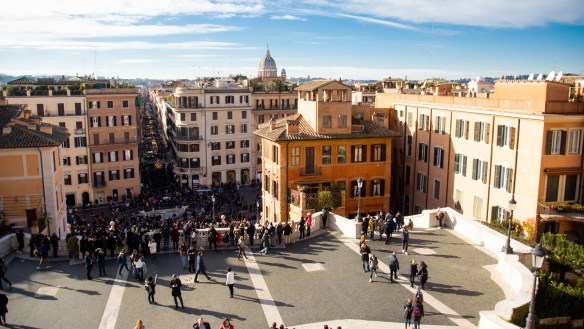
After Trevi, I find I’ve still got time, so I head towards the Spanish Steps (when in Rome…). These 174 steps run from the Bourbon Spanish Embassy to the the Trinità dei Monti church and are the darling of many a famous movie and song. More fountains; ditto, the throngs: it’s because of the latter that one cannot see any actual steps, and for just a moment I wonder if I’ve mis-stepped in coming here.
What steps? But a nice view from the top!
Fleeing the masses, I point my GPS in the direction of an Atlas Obscura oddity: the Santa Maria della Concezione Crypts, or the Crypts of the Capuchin Friars. This ossuary rivals that of the Catacombs in Paris; what it lacks in grandeur it makes up for in creativity. Suffice to say that the artiste took creative liberties in arranging not only the stacks of bones (some 4000 skeletons are (dis)assembled here), but also the various bodies in repose (fully-frocked Friars) and flight (child-sized bodies looking down from the ceiling; skulls with scapula-wings). The walls and ceilings were covered in mandalas and chandeliers, each surface laden with myriad symmetrical designs, all made from individual bones and carefully arranged in gruesome patterns that affected something of a moribund paint-by-number display.
As I wend my way back, I stumble across the We Run Rome road race and flash a 2019 goal to do a 10k (we’ll see!). But first, it’s Pizza for lunch, a trip to a local wine and cheese shop for aperitivo supplies and then back to the B&B to get ready for New Year’s festivities.
Ringing in the New Year, Roman style!
Italians eat dinner late. So an 8:30 dinner is on the early side, but we’ve managed to find some fantastic melanzane parmigiana at a little local place in the piazza near the B&B. New Year’s Eve, thus far: Prosecco and Parmigiana. Next stop, Pyrotechnics.
I’m not a fan of huge crowds or wild New Year’s Eve parties. But since it’s my first in a European city, la Fiesta di Roma is on the docket. It takes place in Circo Massimo (Circus Maximus), the grand sports stadium where they once held chariot races and Ludi, festivals for the gods. In its day, the capacity was 250,000. Tonight, I’d estimate there’s 50,000+ modern Romans. We listen to the weird music, watch the bizarre dance and aerial show (a tribute to the ludi of yore?) and ooh and ahh over the fireworks display over the ruins of the Palatine palace. It may be the most dramatic setting for fireworks I’ve ever seen.
The festival goes for 24 hours, but 2am feels like we’ve been up for a week. We make it long enough to purchase a bottle of bubbly from a street vendor (C’s post-midnight haggling is impressive!) and toast to goals and future adventures.
The finale of the NYE fireworks at Circus Maximus, Rome
*Jet lag avoidance tip #1: when travelling East, stay up as long as possible the day you arrive, so you go to bed at proper local bedtime in an attempt to fool your body into waking up at a moderately human hour the next morn.
**Among other nicknames for the monstrosity are la dentiera (the dentures, in reference to its white marble in stark contrast to its surroundings) and la torta nuziale (the wedding cake).