Costa Rica parte dos: On land, in which I take a liking to some of the locals.

After diving a few days, I joined a tour to the massive Corcovado National Park (42,000+ hectares of land area). They’ve somewhat commoditized and package-ized the outdoor experiences here, which ruffled some of my meander-leaning feathers. This was before the bad dive and the whales, so I was still uncertain of my feelings for the place overall. But I went in with an open mind, a camera, a lot of water, and a desire to see some cool critters.

Check-in at 5:45, load onto the boat at 6, disembark and check-in at the ranger station, bag check for illicit food and plastic (Corcovado is very strict), and we’re ready to go into the park. In my group of 10 was a very nice Italian couple, a trio of French women, and a few others. We walked the trails slowly, with the guide stopping every 50 metres or so to point something out. It felt like he was acting the “guide” part a bit, with a flourish of his scope each time we stopped. Despite the showmanship and the production value, the trails were nice and we managed to see some indigenous species: 2 sloths, 3 tapirs, a smattering of birds and reptiles, a coatimundi, an agouti, and a partridge in a pear tree. Actually, a partridge-type thing (a tinamou), a great curassow, a couple of crested guans, a chachalaca (which is a great sighting if for the name alone), and others.

1 / 7

All-in-all, it felt canned. Like walking through a ‘nature park experience’ rather than hiking through primary and secondary rainforest. And, while I’m not regretful that I went, I’d likely sign up for a different experience if I go again. When I got back to Drake Bay, I booked some time with a local guide to go birdwatching.

The highlight of the day: a couple of Imperials (the local beer) with the Italian couple, some very decent ceviche, and fun conversation, culminating in them urging me to reconsider my domicile in these very bizarre times.


I rode out the hottest heat of the afternoon on the balcony of my hotel room doing some napping and lazy birdwatching from the hammock. The cacophony begins at dusk, when the cicadas announce the exact moment of sunset. It’s amazing, really, the scissor-like crescendo of their song. Track 2 to the evening symphony is the squawking chorus of scarlet macaws as they make their way, 2-by-2 into the jungle to sleep.

I met up with the local birding guide the next day with honestly low expectations after my Corcovado experience. But the magic of the whales prevailed and it ended up being a lovely, if a tad wet bird walk (we got caught in a tropical downpour while looking for toucans), making the memory better, if soggy.

2 / 7

If you are in Drake Bay, I highly recommend William Mora Gomez as a guide. He knows the area like the back of his hand, and his passion for birds and local wildlife shines through.

We ended up going on 2 outings, each time seeing more and more local birds and wildlife. The 2nd walk we took, William had rescued a baby white-face capuchin earlier in the day. The little monkey had gotten zapped on an overhead wire, and William reunited him with his troop. We walked by the same area a couple of hours later and the monkeys were still there, maybe waiting to give some good photo ops in gratitude. I’m anthropomorphizing of course, but it’s nice to wonder if they remember the good humans.

This inspired me to take my own late afternoon walks in-between lazing and diving. Birdwatching is good for the spirit. Looking through a viewfinder focuses your attention and silences the ridiculous chatter in your mind. A nonsense self-conversation about what’s going to happen in 4 days when you’re back in the real world has no chance against a chance sighting of a red-lored Amazon parrot with mate sitting on a nest, close encounters with rufous-tailed hummingbirds, cartoon-ish sightings of fiery-billed aracaris and yellow-throated toucans. Lineated woodpeckers.

It was during these walks, despite the heat, despite the prices (I still have no idea how people without a hefty vacation budget can afford to live there), despite the touristic-centricity, that I came to really appreciate the Pura Vida, pure life, aspect of Costa Rica.

There is a concept in my yoga practice called Iccha: the willingness to allow something, or the opening up to what might be. It had been a long time since I’d really, purely tapped into this energy and it felt like my spirit was trying to come home.

The following day the ocean would redeem itself.

Read Part 1 here.

I spent my holiday doing citizen science in South Africa: Part I

What draws us to elephants is a mystery. Or is it? They represent wisdom and strength and empathy. They are revered in Thailand and in India and elsewhere in Asia. Ganesh is the Hindu elephant god of new beginnings, the remover of obstacles and bringer of wisdom and luck. His name in Thailand is Phra Phikanet.

Across Asia and Africa, these magical and mystical creatures are worshipped in temples and simultaneously loathed in the fields, where their land is being encroached upon by farms and development. A mere “drive by” by a herd can decimate a family’s crops in minutes.

I think I’ve always been charmed by the magic of elephants, intrigued by their human-like behaviours, disgusted by humans’ treatment of them and their habitat. My first visit to Africa gave me a up-close look into those long-eyelashed orbs and I was smitten. It’s not a secret that Ganesh is something of my patron saint, and it’s certainly no surprise that I’m something of a wildlife freak. So when an opportunity to participate in Bring the Elephant Home’s volunteer program, assisting scientists with crucial behavioral research to learn more about social structure, welfare and habitat usage, I couldn’t apply fast enough.

Fast-forward 8 or 9 months, and I’m beginning to pen this on my flight home, coming down from the elephant high that has been my status quo for the last couple of weeks.

I joined the group in Port Elizabeth (recently renamed to Gqeberha), on the Eastern Cape of South Africa: a couple from the UK, a handful of Californians, and a student studying ele behaviour at a University in Johannesburg. From PE, we went up to our post at the Kariega Conservation Center at the Kariega Game Reserve. I posted a blog at the beginning of our time there called What Happens When You Drop a Fence, outlining our initial observations and the main research objectives.


What was it like?

So the 8 of us volunteers, 2 PhD researchers, and a local ecologist ventured out into the thicket of Kariega Game Reserve each day looking for elephants. While like something out of a dream, it also felt much harder than it seemed like it should have been. One might think elephants are so big, and how could you miss them, right? Well, crazy ele fact #1: they move silently. I mean, so silently that you could be sitting in a spot for a while and see or hear nothing, but a moment later, you could glance over your shoulder and see an animal the size of a Land Cruiser standing just metres away, trunk curled, sniffing in your general direction. While you’d think they’d make themselves known by heavy footsteps, their massive feet are so cushioned that they walk as if clad in slippers. In fact, more often than not, we’d know they were nearby only from the branches snapping rather than anything else (the tracking collars, when working, didn’t hurt either 😉).

Day 1

That first afternoon we went out on a game drive to get our sea legs, as it were… we saw zebra and white rhinos and giraffes and warthogs (Pumba!) and of course a few elephants. Even though it was just a couple of hours on the reserve, and we got a flat tire just before dusk and had to wait a while for another vehicle to come and bring us a spare and a new jack, it didn’t feel like a harbinger of doom for the week. Instead, it felt like the beginning of a cool adventure. Especially when I looked up and realised that the giraffes we had been watching on the other side of a hill began to creep in closer to get a peek at what we were up to out there in the scrubby thicket.

The first full day was a series of lectures on why we were there, classes on how to do elephant identification, exercises in what to look for, behaviour-wise, and a slew of what to do when things around age and sex and different behaviours and dung sampling and using the Zoomonitor app to record said behaviours. It felt like a lot.

I mentioned to my manager that we had elephant school that first day. He replied that he had heard they are good learners. Us humans, though… the jury was still out.

One of the first lessons was ageing elephants. It’s done by relative size, facial features, and behavioral characteristics. Calves (<1) can walk underneath an adult cow. Juveniles (1-4) are still suckling but may or may not have tusk buds (squeee!!!). While Intermediates (5-8) may or may not look like sub-adults (9-15), they are weaned and the females take on more and more “big sister” duties. Sub-adult bulls spend less and less time in the center of the herd as they mature and become more independent (and, you know, more like naughty teenage boys!). Adults (15 and up) come in different shapes and sizes, depending on whether they are bull or cow. I learnt so much just this first day on these different stages, not least that bulls don’t even come into their first musth until they are about 25, while cows can start having their own calves by about 11.

Once we had a decent grasp on ageing, we moved on to sexing (size, head shape, body configuration, rear view). About half-way through this lesson I felt like I might fail elephant school altogether, so I was glad that the professionals would be with us in the vehicle to help out with our ID follies!

The team uses the SEEK (System for Elephant Ear Knowledge) system which incorporates a set of features and markings in addition to body condition on a scale from 1 (emaciated) to 5 (chubbo) to identify and code the targets of our observations. I’m grateful for the visual aids we were given, as well as the Elephant Voices ethogram website which we were encouraged to review prior to arriving. This was beginning to feel like work.


The last part of our training day was to review the different behaviours we were to observe and track: continuous behaviours like locomotion, grazing, browsing (and identifying the differences therein), and all-occurrence behaviours like head shake, sniff, play spar, trunk curl, trunk to face (and whose trunk to or from whose face)… again I was appreciative of the technology at hand – the app into which we were to record said behaviours and the myriad PowerPoint decks and references that had been prepared for us novices.

5 / 6

As the long day wound down, we received our marching orders: review the materials and get ready for an early wake up call. We were going into the field in the morning, then breaking up into groups of 3, one to observe behaviour, one to do elephant ID, and one to be the photographer.

One can only guess which role I was more than glad to take on.

Stay tuned for more adventures from a citizen-scientist perspective. And be sure to take a look at Bring the Elephant Home’s updates page for more stories from our time at Kariega.

THIS JUST IN: I just launched my new print store… take a look HERE. And use coupon code TGM-15 for a 15% site-wide discount!

Madagascar marvels part III: What’s this tsingy?

After 10 days of sun and salt and sharks and palms, I did the Malagasy version of planes, trains and automobiles (pirogue and taxi and speedboat and 4×4), meeting up with a local guide and driver to see the national parks in the north of the country. On that first day, I had a bit of shell-shock with a 10 hour drive on terrible, not-quite-paved roads, from the port of Ankify to area near Joffreville. En route, I am sure I inhaled half a kilo of red clay dust, had a pit stop in one of the most unusual outdoor toilets I’ve ever experienced, and fully realised the value of a sea breeze as we drove towards dry season in the interior (hint: 39C feels quite different inland v the coast!).

I spent the hours in the car with a traveller’s guilt: the conflicting feelings of being privileged in affording this kind of trip while simultaneously observing straggly stick homes with no running water, outhouses, skinny zebu, over-farmed land; but also thriving local markets, self-sufficient small villages, and wide beaming smiles on everyone I encountered. I consider how complicated life back home is in comparison.

On this first day, a “travel day”, the saving grace was a quick stop for a nature thingy, a tsingy called Tsingy Rouge. You leave the main highway and wend through a maze of sand and clay-dirt roads to reach it, diggers and roadwork vehicles everywhere. They’re digging and paving in the name of modern infrastructure. As I watched the small rustic villages go by through my window, I considered whether modernization is really worth it. Water, yes. Sanitation facilities, of course. But the chaos these new roads will bring, and the tourism… can the ecosystems sustain the influx?


Tsingy was a new term for me. In Malagasy, it means “the place where one cannot walk barefoot.” As I was to learn, so named for good reason.

Tsingy Rouge is Madagascar’s miniature Grand Canyon. It’s a red (rouge) geologic marvel, formed of eroded laterite and looks like some prehistoric giant played sand castles and then got bored half-way through. It reminded me of a cross between a model of Bryce Canyon and a salt mine, out in the open even though it looks like the bottom of a cave. This place looks like it should be underwater – and it probably was, a million or so years ago – the formations were carved by the rivière Irodo.

7 / 7

At the time, I was road weary and dusty from the drive, but the short walk down into the tsingy and then the sight of some gray-headed lovebirds nesting in the red clay helped me reset. At the lodge that night, I chalked (clayed?) the day off to what it was, and delighted in the thought that tomorrow we’d be hiking through Parc National Montagne D’Ambre, Amber Mountain, and the hunt for chameleons would begin in earnest.

Zoom in on this map to see the different places I visited during the trip.

A slight detour about the climate of Madagascar. As the 4th largest island on this planet, Madagascar is simply enormous. So the country encompasses rainforest through savannah, with a dry season (of which we were at the end) and a rainy season. From zebu to man-on-the-street, it seemed like everyone was looking forward to the rains! In a recent article, The Guardian highlights that these inconceivable temperatures are a clear result of climate change. Entering Amber Mountain was like travelling through different worlds. On the one hand, it was hot and humid, and as we got into the forest the air turned almost sweet. On the other hand, it was so dry that the riverbeds were completely dried up and one of the waterfalls we were to see, there was not enough water for it to actually fall. I was thankful for the lush forest canopy to provide shade.

We hiked to the Cascade Sacrée (Sacred Waterfall) and the Mille Arbres (Path of a Thousand Trees) trail, all the while feeling ensconced in a terrarium separate from the hot and humid outside world.

Montagne D’Ambre feels like its own bioverse, with endemic birds, lemurs and chameleons found specifically in this reserve. It was very cool to actually find some of these critters, including the Amber Mountain rock thrush, the Amber Mountain chameleon, and the very adorable and teeny Mount D’Ambre leaf chameleon (note how small he is on my hand!). While not exclusive to Amber Mountain, the endangered Sandford’s brown lemurs were an amazing find, as was the very weird and master of camouflage leaf-tailed gecko (can you spot it in the last photo in this slideshow?).

9 / 13

Possibly the highlight of the day came as we were exiting the park and really more focused on lunch than seeing any more critters, since the day was already full of such wonderful sightings. As we were driving down the main reserve road, we spotted a beautiful little pygmy kingfisher perched on a branch where he gave us a fantastic view of his bright plumage.

Of all the wildlife experiences on this trip, I think this one wins for the most unexpected sighting. The grin and sheer joy on my guide’s face at the sighting was absolutely priceless.

And, no, I didn’t get a photo of that.

This concludes our tour of Parc National de la Montagne D’Ambre. Stay tuned for Part IV including the most horrible thing in Madagascar and why you need shoes. In other words, next up is hiking in the tsingys of Ankarana.

Birb-spotting: adventures in Covidville.

Not all my adventures in Covidville have revolved around cultivating sourdough starter or rehabilitating broken body parts. Last summer, shortly before I broke said body part, I bought a new camera and a ridiculously big lens. I figured that since all travel was on hold for the foreseeable future (I had no idea how long the foreseeable future really was…), I’d invest in something to help me see the local landscape and its natural wonders a little more clearly.

But, the lens was backordered. And it arrived about a week after I was released from the confinements of my sling. And, at the time, I could barely lift it with my left arm. I nearly cancelled the order a couple of times in my exasperation. But something told me to stay.

The waiting is the hardest part.


So it turned out that birdspotting became a part of my physical, if not psychological, therapy during these disheartening and altogether gloomy months. The fact that you actually need to leave the house (sorry, sourdough starter) and situate oneself in a place where there is a plethora of nature, and an anti-plethora of people, meant that I would need to spend quite a lot of time outdoors (good), in open, quiet spaces (better), where there were few people (best; on a lot of levels).

So while I know a bit about some birds, it was a new learning experience to be able to literally zoom in and see them more clearly. And so, over these past 9 months or so I’ve really birthed a new passion, or at least a new pandemic obsession.

Once again, Nature as antidote.

In the late summer and into the fall, I began getting used to the lens. It’s big and heavy, and my shoulder was healing and I sometimes didn’t know if it was helping or hurting to be hauling this thing around all the time, as I wasn’t really supposed to be lifting any weights until at least the 3 month mark. And I don’t like using a tripod (there, I said it!). And I’m really trying to shoot mostly manual these days. So a lot of the early photos were crap. And I almost just gave up on a few occasions.

Then I went back and visited an osprey nest I know. Getting that much closer to these majestic beings made me better understand why, for me, photography is like meditation. I hold my breath when I shoot, focused for those microseconds on the only thing that exists in that moment: whatever it is in the viewfinder. Ospreys are keen hunters, powerful rockets when honing in on their prey, yet graceful in their strength. I’m in that moment with them, focusing on the target, learning from them their patience and perception and precision and tenacity.

The photos that came from that outing lifted my mood and made me want to get better. Physically. Mentally. Photographically.

Hummingbird

Throughout the fall, there were more ospreys and the autumnal waterbirds… and then, week by week, they began to fly south to winter. Which, of course, I wanted to do as well: fly somewhere as the days grew shorter and the Covidness became darker and seemingly unending, unyielding, unrelenting, un…….

With winter on the fringes, ospreys and egrets are replaced with a parade of literal snow birds arriving on the scene. We get snow geese and snowy owls and snow buntings, plus the wintering birds of prey like bald eagles and short-eared owls and hawks of all sorts. All of which were a thrill to see, and maybe a bit of an obsession in trying to find. And a good way to wile away the cold and dark days.

And as seasons go, so do the migration patterns. With the thawing rivers and marshes, the wintering birds fly elsewhere, and longer days bring with them the sights and sounds of spring: early April the ospreys begin arriving again. Then the reeds are alive with the sounds of warblers. Then the vibrant bluebirds give way to orioles and thrushes and kestrels and waxwings and tanagers. Spring indeed is a cacophony of birdsong, plumage and mating dances.

One of the joys of living near the shore is the return of the shorebirds. I’m seeing an influx of the ducks and egrets and sandpipers that can only mean that brighter, warmer, longer days are upon us.

Which brings me to this week. Although the piping plovers return at the beginning of April, they don’t get to nesting in earnest until sometime in May. There are only roughly 7500 piping plovers in existence, about half on the East Coast of the US. Every chick is sacred, as they say. I’m very respectful of distance and restricted beaches (most of their nesting area is roped off or beaches completely closed to help protect the species), so the long lens helps a great deal!

My pandemic patience and persistence practice, as well as my affinity to avoid crowds have paid off: I’ve found some baby plovers and their relatives.

Piping plover hatchlings can eat on their own on the very first day but won’t fly for about a month. In the process, they peep and skitter across the sand like little worm-eating machines, learning about life in the big bright world as they go. And, boy are they cute!

And there are the killdeer: I’ve created something of a narrative around these birds even though they are slightly less adorable. I’ve been looking for killdeer chicks the past couple of weeks in a place I know there’s a nesting pair. A few days ago one of them was acting really strange so I had an idea there may be chicks around. I went back just before dusk on Friday and finally found them… It was like a small avian circus really. Killdeer are cousins of the plovers and so their chicks are also precocious – the technical term is precocial, meaning they can feed themselves and move around right after hatching, but precocious is more like it. Cheeky, even.

I digress.

Killdeer #1 was tending the flock (4 or 5 that I could see), and as the sun got lower s/he started to gather them underneath her to settle in. But as soon as they all seemed to tuck in, one would pop out and start exploring again…then another…and another. And then s/he had to go herding. At one point, s/he got so exasperated that s/he called her mate to take over. S/he flew off and complained to the willet sitting on a dirt mound nearby while the mate took over fledgling-wrangling duties.

The look on the poor birb’s face was something like a bedraggled mother trying to wrangle scurrying toddlers: “ffs, if you don’t get in here right now Wally, that giant pterodactyl is going to come down and grab you and you’ll never eat any of those yummy marsh grubs again!


It’s been a rocky time in Covidland. I’m grateful daily for relative health and a job I love and and a modicum of sanity and the luxury of being fully-vaccinated…but I’m not taking any of it for granted because it all still feels a little precarious right now.

So my bird tales end here for the day, but the lessons I’ve learnt from birdstalking with a larger lens are clear:

  • Do the thing if you can, especially if you get to learn something new in the process
  • Find nature, experience open spaces, smell the leaves, listen to the birdsong
  • Stay focused on what’s in front of you; there’s a lot of swirling chaos out there that will exist whether or not you pay attention
  • After you’ve gone through a bad day (or a string of them), congratulate yourself for the accomplishment…nobody else may have even noticed, as their days may be equally as trying as yours
  • Bring snacks. It’s easier to stay a little longer doing a thing you didn’t know you’d enjoy if you’re not starving!

Here’s to brighter skies, warmer days and a return to adventuring in earnest.

Seychelles, Part I: Dinosaurs, Jurassic beaches and going it by bike.

[Seychelles: Part II] [Seychelles: Part III]

After contemplating even farther-flung possibilities (and deciding they’re not possible within our time constraints), somehow we settle on the Seychelles: warm water in which to dive, jungle to explore, the possibility of seeing interesting critters, some fantastically cool topography…flights, booked!

Thank you, Google Maps

Year of Africa continues. There’s always an elephant.

I arrive on the main island of Mahe first, whisked away by an uber-efficient taxi driver, and am greeted in my hotel room by a towel creature in the form of Ganesha, the elephant-god and my patron saint of sorts, bestowing well-wishes on a weary traveller. He’s my reminder that obstacles may be removed to charm a journey but may also be placed in the way as tests of mettle, meddle and might…all of which one might encounter on holiday in as far-flung a place as a speck of an island in the middle of the Indian ocean.

“Actually, the best gift you could have given her was a lifetime of adventures.” – Lewis Carroll

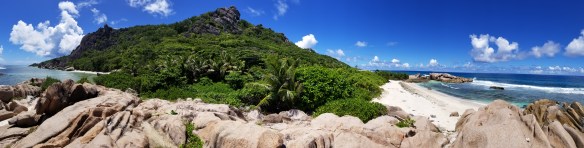
The Seychelles are volcanic islands, and as such, where jungle meets beach is displayed in spectacular form. Look inland, and the lush hills remind you of a scene straight from Jurassic Park – you expect to see T-Rex or one of his contemporaries bounding through the jungle brush at a moment’s notice. The enormous granite rocks that jut out of the sand like monstrous dinosaur teeth invite one into the bathwater-temperature ocean (if you dare…).

After a lazy day fending off jetlag, it’s an early airport run to fetch my flight-weary Calvin, travelling companion (and human) extraordinaire, then a dash to the ferry to take us to La Digue, leaving the relative civilisation of Mahe behind: traffic and construction and bustle, the din of a small city bursting at the seams, desiring to be something larger than it ought. Funny that what we call progress ends up shuttering out the natural world in favour of big buildings, motor vehicles and pavement. Regardless, we’ll be back to spend a day here on the other end of our week’s adventurings.

What we didn’t realise at the time was that this lorry would haul us up the mountain later in the week…

We arrive on La Digue on a Sunday. It’s noticeably quieter than Mahe, the town itself (La Passe) bustling in that charming way you’d expect from an idyllic island where there are few cars and everyone gets around by bicycle. And because we haven’t obtained our bikes yet, we walk the 1.2km to the guest house, up and down the hills that are to become familiar this week, “Left! Left! Left!” on the mind, because even though there are very few cars, there are bikes (and European tourists and Aldabra tortoises) to dodge. English colonisation here has left at least one vestige: left-side driving.

It’s during this walk, about half-way to the guest house, where we encounter our first free-range tortoise.

An aside on the Seychelles and the Aldabra giant tortoise: Seychelles is an archipelago, consisting of 115 islands of all sizes, plunked in the middle of the Indian Ocean, east of Somalia (yes, there are the occasional pirates) and north of Madagascar (and unfortunately no lemurs or other primates). The farthest-flung outer islands are 1100+km from where we are. One island, Aldabra, is a World Heritage Site and the Indian Ocean’s answer to the Galapagos. Its native species include the Aldabra Tortoise, some of which have made their way to La Digue over the centuries. Being easy prey and a good source of food for La Digue’s earliest residents, the La Digue subspecies of the Aldabra giant tortoise is extinct, so the ones that remain on the island are the original Aldabra variety, many of which are kept, quite loosely, as pets.

Needless to say, encountering a 200-kilo walking dinosaur as you drag your luggage uphill on a 30° C day (with equal humidity) is more than enough reason to stop for a fresh fruit juice by the side of the road and interact with local (semi)wildlife.

☀️☀️☀️☀️☀️

We’re here mostly to dive, but our first full day on the island is spent exploring the world-renowned Anse Source d’Argent. This famous beach (Castaway and Crusoe were filmed here) looks even more unreal in person than it does splattering the pages of every travel mag’s world’s best beaches issue. Je suis d’accord.

To get here, a pleasant bike ride takes us to the southern end of the island, through a vanilla plantation that rends the air a sweet and salty mix. The path to the beach goes by the park’s tortoise pen; a weird sight really, with dozens of the massive reptiles lazing in the sun and engaging with chattering tourists who feed them leaves and grass in a United Nation’s collection of languages.

Then, it’s down some jungly paths which end at the promised Anse. It looks like a lost paradise; a sort of déjà vu, because the beach looks both familiar and surreal mere steps from the throngs of tourists sunning themselves (they don’t show you that on the InstaWeb). But we’ve come south of the equator largely to escape the world at large, so trekking farther south to flee the selfie sticks and instaglamourous beachgoers seemed the right option. Also, the tide was coming in. So we earned some of our adventure points* this day by coining a new water sport: aqua-hiking. The water, waist-deep (my waist) by the time we returned from our exploration, was a refreshing yet balmy bath verging on hot at water’s edge – in hindsight, more than a foreshadowing to what a warming planet had to reveal under the surface.

We’re rewarded mere metres from the selfie-crazed masses: we manage to find a completely empty beach and encounter only a handful of humans between Anse Source d’Argent and the southernmost tip of La Digue. The location scouts got this right.

After the aqua-hike back to the throngs, lazing a bit, and an attempt at sunning ourselves to dry out, we decide to air-dry instead: more biking, up and across the island, to Grand Anse.

An overall fantastic day awarded us our first set of adventure points for the trip: 5 for the aforementioned aqua hiking and discovering deserted beaches; 1 for bikes as mode of transport, navigating the wrong side of the road, and dodging the errant tourist and meandering tortoise; and 1 more for feeding (albeit captive) living dinosaurs, aka, giant tortoises.

Tomorrow, we dive.

[Read C’s words on the trip here] [Seychelles: Part II] [Seychelles: Part III]


*A couple of years ago, C and I devised a system of adventure points to reward ourselves for tackling and completing myriad explorations and adventures. The silly ranking system takes into consideration physical effort, wildlife encounters, natural wonders, vistas, summits, mishaps, getting lost (we do this sometimes), finding unexpected treasures, being gobsmacked by the natural world, getting dirty, getting wet, and other general adventuring. [“let’s go exploring…”]