A long weekend in the Maritimes

Last 4th of July weekend, I went up to Vermont to ride the Cross-Vermont Trail, a 100-mile stretch of linked trails traversing the middle of the state. So, when looking at the calendar and the way the holiday fell in the week, it made sense to do another bike trip this year.

Work schedules have been madness, and so a few days prior to the blocked time off, there was no real plan… except to go North. Canada. We decided to wing it: spend a couple of days in Prince Edward Island (mussels, lighthouses, no idea what else) and then a couple days in Nova Scotia (ditto: no idea what to expect, except that I’d been there about 30 years ago and I remember the crazy tides in the Bay of Fundy). A couple of years ago I went up to Maine over 4th of July to see puffins… so I put in an order for sea parrots as well. You know, just in case.


With a Plan partially-baked, we set off. 6am departure and half a gazillion hours later, we arrive at our destination: a very sweet historic guest house in Charlottetown. I’ll admit that my expectations were lowering by the block as we drove there through strip malls and industrial areas that could have literally been anywhere else. But patience prevailed and the box stores and faceless motels gave way to tree-lined streets and lovely brick architecture in the historic downtown area.

We were zonked and starving, but found an Irish pub (we’ll come back to the Irish in a bit) and ate very respectable mussels and pub food and listened to some very respectable live music before crashing entirely. I’ll gloss over the part where we got back to the guest house and the key didn’t fit and we had to call the guy and get a new key. It was late but hard to be annoyed because the rumors are true: Canadians are really nice. Even when they screw up and you’re completely shattered and it’s lightly raining and midnight and all you want to do is go to bed.


Enter, bikes.

Even though clouds threatened the next morning, we set out to do a 30-mile loop in the PEI National Park. It turned out to be a really nice ride on gravel roads and jetties through the Robinsons Island section, and on the road for the rest. Lighthouses, check. Thriving dunes and red sandstone cliffs and pink-tinged beaches: also, check! The rain held off and we explored the rest of the national park by car and foot. A flat-calm Atlantic Ocean washed the fragments of work worries out to sea.

That evening we set out to wander the cobbled Charlottetown streets in search of dinner. An aside: I’ve recently adopted a new dog who is so different from my old one in many ways. One thing is that while walking, he will stop dead in his tracks to dramatically sniff the air in hopes of being magnetically guided towards wafting scents of backyard BBQ. I share this because, as we navigated down Great George Street looking for dinner, we walked past a waft of something good. So good, in fact, that as we arrived at the restaurant we were heading to, we stopped dead in our tracks, sniffed the air and were magnetically guided away from that and towards the spices emanating from Punjabi Bites, a local Indian joint. I have eaten a LOT of Indian food here and abroad (including in India), and so when I told the waitress at the end of the meal that it would be worth coming back to PEI just for their food I was not at all kidding. It was really some of the best Indian food I’ve ever had.


Bridge (droichead), not ferry.

The finger-like islands of the Canadian Maritime provinces are connected by a series of bridges and ferries. We decided to take the scenic route and drive across from PEI to Nova Scotia. There are plenty of French influences up here, but what I didn’t know or expect was the Scottish and Irish heritage still lingering as a result of descendants of refugees from the Irish Potato Famine. So as we made our way towards Cape Breton Island, at the top of the province, it was odd to see the road signs begin to change from French to (of all things) Gaelic subtitles. In addition to the First Nation place names and signage that abounds in the region, Gaelic is also widely spoken in these parts.

The Puffins, who thankfully don’t really care which dialect you speak as long as there is enough herring available, played not a small role in the destination choice (grateful for the Internet: a puffin boat trip magically booked from the car!). That and the Cabot Trail. Which I had no idea even existed just a few days earlier.


We rolled into the town of Baddeck (pronounced ‘buh-deck’) in time to drop off stuff at the inn, wander briefly, then get back into the car to traverse the bridges and windy roads flanking Big Bras d’Or, the ginormous lake or inland sea that feels like part Maine, part Vermont; the woods and sea and hills playing alternate roles in rolling out their finest scenery for all to share.

On-board the little birdwatching boat from Bird Island Boat Tours, Captain Ian put on a vaudeville-esque show while the puffins, eagles and other seabirds darted around us. It was nice to be out on the water, taking photos of these cartoonish cuties. I felt silly and light and very, very grateful to be right there as I was furiously chasing birds through my viewfinder.

4 / 12

The skies opened up in the morning, dashing any thoughts of a nice bike ride. Instead, we headed up the Cabot Trail, so named for the Italian explorer Giovanni Caboto (John Cabot), who sailed the ocean blue in 1497 and (re)discovered Newfoundland and Cape Breton Island. He may or may not have been friends with or inspired by a certain other Genoese sailor who claims to have discovered America a little farther south 5 years earlier. And even more unclear is whether this Cabot has familial ties to the Boston Brahmin Cabots for whom the main street in my town is named.

The Cabot Trail is a stunning roadway that circumnavigates the uppermost portion of Cape Breton Island, wending its way along the coast and around the densely wooded forest in the middle, home (apparently) to moose-a-plenty and Cape Breton Highlands National Park. The (apparent) moose did not appear, so I’ll have my moose-radar tuned on high next month when I’m up in Northern Maine. Stay tuned.

5 / 8

That first day on the Cabot Trail we began on the East side and went counter-clockwise, ducking in to hike a few of the little loops along the road, including the Franey loop (its stunning views might have been even more-so with clearer skies), a stop at a genuine general store for gas (replete with a 1950s-era pump attached to a large tank!), and a glimpse of the Lone Shieling, a replica of a Scottish shepherd’s hut along a path that also hosts a stand of 350-year-old sugar maples. Rain or non, the landscape was magnificent.

6 / 7

When in, erm, Ireland (?), you go to a local pub to hear local music. Or something. So there is a section along the coast called Chéticamp, which is Acadian, Mi’kmaq, and a little Scottish. It’s a peculiar little enclave that looks like part fishing village and part sea-level summer camp. There are about 6 restaurants, a couple ice cream shops, and a string of seaside motels catering to summertime fun. It was about 8:30 and as the sleepy village was about to shut down, we grabbed a table at the local Irish-ish bar and stayed for the band. Fish and chips: fab; Band: well, meh!


The rain persisted, so our last day was spent doing The Cabot Trail the other way around: a surreal walk on the foggy, spooky Skyline Trail, fog-dodging along the road as we drove along the coast, and a visit to a quaint whale interpretive center in Pleasant Bay, plus kilometres upon kilometres of ridiculous views as the fog came and went. The Cabot Trail is nearly 300 kilometres long, each twist and turn of the road holds something to discover.

7 / 8

Back in Baddeck, the last plan before the long slog home in the morning was to attend a local cèilidh (pronounced Kaylee), a traditional Gaelic musical gathering. What wholesome fun it was to spend a couple of hours after a really nice local seafood dinner listening to amazing local musicians play guitar and fiddle, tell stories, and share tea and biscuits with the audience.

Maybe next trip we’ll order a better forecast, but all in all, I think we crammed as much as possible into these few days up north. I’m sure there are moose up there… somewhere!


Print shop coupon alert!

I have puffin prints available and will soon have more cards up on my photography shop!

Use code TGM15-1 for 15% off your purchase of puffin prints and more.

How to eat an elephant: on riding 90 miles in Vermont on a rainy long weekend in July*.

*Note: no elephants were harmed in the writing of this blog post.

Desmond Tutu famously said that it is best to eat an elephant one bite at a time. Having spent a small amount of time in the presence of elephants and much of my life as a vegetarian, it is ill-advised (the food choice, not the lesson).


Several weeks ago, a friend and I started talking about distance cycling and bike-packing. He’s a long-haul kind of cyclist, where I am a weekend warrior, riding 5 or 10 miles, sometimes 20 or 30, depending on my mood. I’ve done a handful of 40+ mile (~64km) rides, but with no consistency or methodology. So when we started talking about the Cross-Vermont Trail, which had recently added a new bridge and some additional bike path sections, the ride sounded long but nice. It was more of a passing conversation and felt like more of an aspiration to me.

Somehow, the conversations turned into reality, then gear accretion. So now I was the proud owner of panniers and a new light set (add, later, fenders and additional rain gear!). And if you have the equipment, well, you’ve got to use it…


The Cross-Vermont Trail is a self-described “patchwork quilt”: ~90 miles (~145km) in 12 stages of trail and road, stitched together to traverse Vermont and follow the Wells and Winooski rivers from the town of Wells River to the banks of Lake Champlain in Burlington. It goes along gravel roads and wooded fire roads, country lanes, scenic bike paths and (where absolutely necessary) routes 2 and 302. Click here to see the route in its entirety.

4th of July weekend seemed to be a good opportunity to take a stab at it. In my head, we’d do it in cozy legs: 30 miles a day, see some pretty covered bridges, eat some ice cream, do a little antiquing and town-wandering in between the segments. The plan evolved to riding it in 2 legs, bisecting the journey in Montpelier (note: pronounced “mont-peel-ier” to my non-native New England dismay and discomfort).

Reality: more legs than ice cream. Add in the gods of inopportune monsoons piling their own thoughts onto the subject.

So we ended up riding the first half (~40 miles or so) on day 1, somehow dodging the showers that were forecast; even seeing some much-appreciated breaks of sun. The ride was mostly pleasant: pine and gravel fire roads through old rail trail sections, manageable hills, nice river views, and few people about. Okay, there was the very stupid wipeout after I lost traction on a washed out sandy patch (a mere flesh wound…). And there was the sketchy stretch of route 2 in Marshfield or Plainfield with fast traffic, a surface that had been graded for repaving, and tight, gravelly shoulders which made for a nerve-wracking 10 or so miles (especially after one big truck with a trailer made a WAY too-close-for-comfort pass).

Perseverance pays off, though. Entering the charming city of Montpelier proper via their carefully-manicured bike path, wending across old railbeds, then riding squarely through the center of town, made the band-aided knee and those scary asphalt memories melt in moments!

Between the lingering haze from the Canadian forest fires, the heavy clouds, and what felt like 900% humidity, that night the air felt impending. Impending What was the question. We didn’t want to find out, so made the decision to wait out the rain, spend an extra night here, and play tourist for a day in Montpelier (mont-peel-ier).

Montpelier was quiet. Eerily quiet, in fact. We had passed the Barr Hill distillery on the way in, lending itself to ideas, as did the post-ride bees knees cocktails. So to dodge raindrops, we wandered around the city, visited Barr Hill for history and honey gin (their story is worth a visit on its own), and took in a weird matinee (Asteroid City) at the adorable Savoy theatre (their real buttered popcorn is also worth the visit!). I can’t imagine a better way to spend a rest day.

9 / 14

The ride: Day 2

When the early morning wake-up call featured light showers, I was worried that the day might be a washout that would see us pedaling for 11 hours in the rain. But somehow we again dodged the worst, and by 7:30 the streets were drying and the showers stayed at bay.

I don’t know which leg of the ride I enjoyed more. The 2nd half was more road than trail, but the roads were dirt or gravel and transported us through farms and quaint neighbourhoods, over wooden bridges and along the Winooski river. In some spots the hills won, and my pride hurt more than my legs. Climbs aside, the ride – roughly 50 miles of it – was rewarding and inspiring in so many ways. I’m grateful to the weather for cooperating. I’m grateful to my riding partner for being patient and supportive and funny. I’m thankful for the CVT association for building such a nice trail network. We encountered smiling cyclists and courteous locals throughout the day, even a trio from Canada who were on day 9 of a huge loop through Vermont and Mass.

There’s always an elephant. Take small bites…

The bites: I spent the 2 weeks prior to the trip dodging raindrops at home, stealing short rides when possible, and pounding on a trainer in my living room after work (saddle-time, as it were). I took what was in front of me on each leg of the ride and tackled each section of the ride: the rolling hills and gravelly and slippery parts, even the hardest climbs, one by one… It wasn’t the longest ride ever, or the most difficult, but when we finished with a quick view of Lake Champlain and were met (us sweaty and probably a little stinky), by a smiling chatty driver who piled the bikes in the rear of the van and shuttled us back to the car in Wells River, it all felt just a little bit perfect.

The skies opened up during the car ride back, and I thought, as we watched a bear run across the highway and the postcard-esque New England scenes flash by: I feel good. I’d like to do this again.

Seychelles, Part II: Into the (semi) deep, a climb, surrender, and the reward

[Seychelles: Part I] [Seychelles: Part III]

This morning, we load up the bikes with dive gear and the day’s necessities and point ourselves towards the dive shop. The sky shines a vivid, almost musical blue, and the sea competes with an azure rainbow; variegated cyan delineating reef from sand.

We had seen the rocky mound of an island from land, its sole palm reaching for the sky as if trying to escape Poseidon’s wrath. Ave Maria, it’s called; there’s no use attempting to mix metaphors here. This is our first dive site.

The Seychelles’ reef system has suffered much the same fate as others in this ocean: a bleaching event a couple of years ago and a subsequent coral die-off, which leaves me sad but not surprised that the vibrancy isn’t as I’d hoped. It seems to be trying to come back, though, and the fish are here to stay. We see a few green sea turtles, and some decent-sized schools of fish; moray eels, humphead wrasse, unicornfish, triggerfish, butterflyfish and puffers; octopi, cowfish, un petit requin (black tip), moorish idols, and that silly-looking yellow and black one with stripes and spots whose name I’ve forgotten…we’re even graced with the appearance of the elusive pipefish. Clownfish are few, alas, as there are few anemones in which they live. But we tally 5 adventure points for the dives, including C’s earned by fending off a rogue sea urchin. This mermaid’s fins are sated for now.

Back on land…

As if the day’s humidity weren’t enough to sap one’s strength, we decide to ride our (15ish kilo) bikes up the island’s highest hill to take in the view at Nid d’Aigle. The road winds its way up, the hills at a 45° angle to the rest of the world; the humidity rivalling the consistency of, say, lobster bisque. Biking gives way to pushing said (leaden) bikes, which eventually leads to surrendering to the elements (we are, by this point, more liquid than solid humans; sweat becoming just another layer on top of sun cream), depositing them at the side of the road to climb the rest of the way à pied. This is one of the steepest roads I think I’ve ever been on, but the reward here is the view (bonus: also the restaurant, Belle Vue, from which we’re vue-ing makes the best fruit juice on the island). We make reservations to return the following night for dinner and sunset (transport inclus), then continue upwards on the gnarly trail behind the place to the mountain’s peak (hint: the view from the restaurant 350 metres below was better).

Adventure points earned: 1 for biking up the absurd hill on leaden bikes; 2 for surviving without suffering heat stroke; 1 for hiking into the jungle, to the top of la montagne, and not falling to the same fate as the storied German*.

One final adventure point is earned for wildlife encounters on the way down: a free-range tortoise greets us, out for its morning stroll (at a tortoise’s pace…arriving to us in the height of the afternoon), enjoying a snack of freshly-fallen mangoes. C befriends the beast and they share a moment.

☀️☀️☀️

The next day’s dives are similar to the first, with a parallel state of corals and ditto sea critters. They are nice dives with fun swim-thrus and more interesting granite structures than the previous day, sea flora painting the rock its underwater patina. This being a nice but unimpressive dive overall, I was not prepared for what we saw next. As we exited a swim-thru and rounded a corner, a massive, majestic, magnificent marbled ray defied not only the m-adjectives, but my expletives as well, by making itself known. It was nestled between two rocks, flanked by several smaller stingrays, seeking or providing protection, I am not clear. We stayed close, watching their behaviour, the smaller rays coming and going, fawning over the larger in almost a caress; nature never ceasing to amaze. It is at these times I feel fortunate to be a diver, experiencing the undersea world in childlike awe and wonder, as if given special access to explore another planet.

Back on dry land, we bike to the north and then to the east (La Digue map), to where the road ends at Anse Fourmis; jagged rocks teasing the way to a jungle path we are determined to explore when we’ve got more hours (not tonight, tho, we’ve got a date with a sunset). The surf is wilder here, the rocks sharper: testament to a more exposed coastline on this side of the island. The views no less spectacular, and we’re awed anew.

Adventure points earned: 10 for the diving (attributed mostly to the ray and its entourage) plus one for the evening: a lorry ride up and down the giant hill, a sunset dinner and an overall lovely day. I fall asleep with a smile on my face and can’t recall the last time I road a bike with a basket in a bikini.

More diving the next day and a half, adding a handful more adventure points to the tally. The sites are good, but Pemba is still at the top of our list of favourites. We see dolphins from both the room overlooking the ocean, and the boat during the surface interval off Grand Soeur island. There are small black-tip shark sightings, barracuda, moray eels (one more massive than most!), swarms of Indian ocean fish… A collection of fun dives with more granite rock formations to swim thru and sea turtles to swim beside. There’s also a lovely little yellow frogfish, adding to the list of sea critters I’d not seen before this trip.

The diving has been fun thus far, but the end of the road calls… back on La Digue, we mount bikes and head for Anse Fourmis again, and our quest to reach Anse Cocos. It’s like a Monty Python meets Indiana Jones meets Bear Grylls: we’re not 200 metres into the jagged, rocky, jungly trail as the clouds decide to open and release monsoon-like rains. We can continue on and risk life and limb on the rocks and jungle brush, or play it safe and return the way we came. Opting for the latter, the bike ride home is like a 7-year-old’s dream: fat, warm raindrops form giant puddles through which we splash, laughing. We’re soaked to the core when we come across one of the local roadblocks: a massive tortoise, looking spic and span in the downpour. They’ve not yet become a novelty, so we stop to share our oranges with this friendly beast. It is not possible to be more drenched than we already are.

Adventure points earned this day: 1 for the dive, another for a remora that took a fancy to C and remained our dive buddy for the entire dive; add one for bushwhacking and jungle hiking in the rain.

☀️☀️☀️

It is only in hindsight that we declare, “do not eat the chef’s special.”

We return to Anse Banane by bike in the inky darkness, a headlamp and a torch lighting our way through the still-damp night. We’ve come to a highly-recommended restaurant, with its charming décor and seating facing the ocean, the storm-fueled waves crashing fervently across the way. The meal, a lovely smorgasborg of salads and fish of all styles: curry, fritters, grilled (chef’s special), with a home-made banana cake for dessert.

The day, the dives, the hike and the silly soggy bike ride: excellent. The night: not so much. We both wake in the wee hours, reeling from what can only be food poisoning. Details spared, this dashes our last diving day (my 1.5km bike ride to the dive shop to let them know we’re half-dead nearly does me in for good) and has us horizontal, indoors, for the day. With one foray to the beach in a failed attempt at a swim, we retreat to the relative safety of the hotel to recuperate and commiserate. This is not how we wanted to spend our second to last day here…I know C is cursing the elephant. Survivor points: 5.


*About the German: local lore tells of a German tourist who hiked up to Nid d’Aigle with his fellow travellers, spotted a house he wanted to see again, and went back up the mountain on his own. He was never heard from again; search teams and dogs couldn’t even find him. We heard this over lunch from the owner of a café on our way up to Nid d’Aigle…whether the story has morphed into island legend, we’re not clear.

[Seychelles: Part I] [Seychelles: Part III] [C’s recount of the week]

Seychelles, Part I: Dinosaurs, Jurassic beaches and going it by bike.

[Seychelles: Part II] [Seychelles: Part III]

After contemplating even farther-flung possibilities (and deciding they’re not possible within our time constraints), somehow we settle on the Seychelles: warm water in which to dive, jungle to explore, the possibility of seeing interesting critters, some fantastically cool topography…flights, booked!

Thank you, Google Maps

Year of Africa continues. There’s always an elephant.

I arrive on the main island of Mahe first, whisked away by an uber-efficient taxi driver, and am greeted in my hotel room by a towel creature in the form of Ganesha, the elephant-god and my patron saint of sorts, bestowing well-wishes on a weary traveller. He’s my reminder that obstacles may be removed to charm a journey but may also be placed in the way as tests of mettle, meddle and might…all of which one might encounter on holiday in as far-flung a place as a speck of an island in the middle of the Indian ocean.

“Actually, the best gift you could have given her was a lifetime of adventures.” – Lewis Carroll

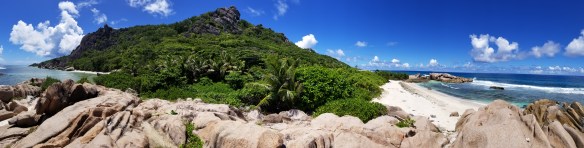
The Seychelles are volcanic islands, and as such, where jungle meets beach is displayed in spectacular form. Look inland, and the lush hills remind you of a scene straight from Jurassic Park – you expect to see T-Rex or one of his contemporaries bounding through the jungle brush at a moment’s notice. The enormous granite rocks that jut out of the sand like monstrous dinosaur teeth invite one into the bathwater-temperature ocean (if you dare…).

After a lazy day fending off jetlag, it’s an early airport run to fetch my flight-weary Calvin, travelling companion (and human) extraordinaire, then a dash to the ferry to take us to La Digue, leaving the relative civilisation of Mahe behind: traffic and construction and bustle, the din of a small city bursting at the seams, desiring to be something larger than it ought. Funny that what we call progress ends up shuttering out the natural world in favour of big buildings, motor vehicles and pavement. Regardless, we’ll be back to spend a day here on the other end of our week’s adventurings.

What we didn’t realise at the time was that this lorry would haul us up the mountain later in the week…

We arrive on La Digue on a Sunday. It’s noticeably quieter than Mahe, the town itself (La Passe) bustling in that charming way you’d expect from an idyllic island where there are few cars and everyone gets around by bicycle. And because we haven’t obtained our bikes yet, we walk the 1.2km to the guest house, up and down the hills that are to become familiar this week, “Left! Left! Left!” on the mind, because even though there are very few cars, there are bikes (and European tourists and Aldabra tortoises) to dodge. English colonisation here has left at least one vestige: left-side driving.

It’s during this walk, about half-way to the guest house, where we encounter our first free-range tortoise.

An aside on the Seychelles and the Aldabra giant tortoise: Seychelles is an archipelago, consisting of 115 islands of all sizes, plunked in the middle of the Indian Ocean, east of Somalia (yes, there are the occasional pirates) and north of Madagascar (and unfortunately no lemurs or other primates). The farthest-flung outer islands are 1100+km from where we are. One island, Aldabra, is a World Heritage Site and the Indian Ocean’s answer to the Galapagos. Its native species include the Aldabra Tortoise, some of which have made their way to La Digue over the centuries. Being easy prey and a good source of food for La Digue’s earliest residents, the La Digue subspecies of the Aldabra giant tortoise is extinct, so the ones that remain on the island are the original Aldabra variety, many of which are kept, quite loosely, as pets.

Needless to say, encountering a 200-kilo walking dinosaur as you drag your luggage uphill on a 30° C day (with equal humidity) is more than enough reason to stop for a fresh fruit juice by the side of the road and interact with local (semi)wildlife.

☀️☀️☀️☀️☀️

We’re here mostly to dive, but our first full day on the island is spent exploring the world-renowned Anse Source d’Argent. This famous beach (Castaway and Crusoe were filmed here) looks even more unreal in person than it does splattering the pages of every travel mag’s world’s best beaches issue. Je suis d’accord.

To get here, a pleasant bike ride takes us to the southern end of the island, through a vanilla plantation that rends the air a sweet and salty mix. The path to the beach goes by the park’s tortoise pen; a weird sight really, with dozens of the massive reptiles lazing in the sun and engaging with chattering tourists who feed them leaves and grass in a United Nation’s collection of languages.

Then, it’s down some jungly paths which end at the promised Anse. It looks like a lost paradise; a sort of déjà vu, because the beach looks both familiar and surreal mere steps from the throngs of tourists sunning themselves (they don’t show you that on the InstaWeb). But we’ve come south of the equator largely to escape the world at large, so trekking farther south to flee the selfie sticks and instaglamourous beachgoers seemed the right option. Also, the tide was coming in. So we earned some of our adventure points* this day by coining a new water sport: aqua-hiking. The water, waist-deep (my waist) by the time we returned from our exploration, was a refreshing yet balmy bath verging on hot at water’s edge – in hindsight, more than a foreshadowing to what a warming planet had to reveal under the surface.

We’re rewarded mere metres from the selfie-crazed masses: we manage to find a completely empty beach and encounter only a handful of humans between Anse Source d’Argent and the southernmost tip of La Digue. The location scouts got this right.

After the aqua-hike back to the throngs, lazing a bit, and an attempt at sunning ourselves to dry out, we decide to air-dry instead: more biking, up and across the island, to Grand Anse.

An overall fantastic day awarded us our first set of adventure points for the trip: 5 for the aforementioned aqua hiking and discovering deserted beaches; 1 for bikes as mode of transport, navigating the wrong side of the road, and dodging the errant tourist and meandering tortoise; and 1 more for feeding (albeit captive) living dinosaurs, aka, giant tortoises.

Tomorrow, we dive.

[Read C’s words on the trip here] [Seychelles: Part II] [Seychelles: Part III]


*A couple of years ago, C and I devised a system of adventure points to reward ourselves for tackling and completing myriad explorations and adventures. The silly ranking system takes into consideration physical effort, wildlife encounters, natural wonders, vistas, summits, mishaps, getting lost (we do this sometimes), finding unexpected treasures, being gobsmacked by the natural world, getting dirty, getting wet, and other general adventuring. [“let’s go exploring…”]

Zanzibar Part I: Pemba Magic

The tropical air hits my senses as I step off the plane and onto the tarmac. Warm, dense, smoky, organic air that wraps itself around you like a woolen blanket on a 27-degree (C) day. This air feels almost colourful and somehow different than the Central American jungle aromata I’ve experienced. There is a tinge of jasmine and spice and human je ne sais quoi…

Onward.

I complete the form and hand it to the immigration officer. “How do you like your President Trump?” is the first question I’m asked on African soil as I hand over my US passport. And so, the first interaction here is laced with humour; the local smiles are infectious and inviting. I’m travelling with my co-adventurer, Chris, the Calvin to my inner Hobbes, and we’ve just landed in Zanzibar, the semi-autonomous archipelago off the coast of Tanzania in East Africa. We’re not in Kansas anymore.

And so begins my first foray onto this new and exotic continent. We board the 12-seater Cessna that will transport us from bustling Ugunja (the main island, to which we’ll return at the end of the trip for a day of sightseeing) to rustic and less-travelled Pemba, for a week of diving in its pristine waters 50km to the north. I’ve been incredibly busy these past weeks, and have had little time to do much more than find lodging. So what I know of where we’re headed is roughly this: Pemba is a volcanic island (unlike Ugunja, which was attached to the mainland at some point in its geological evolution); as such, Pemba is purported to be hillier and more lush than its sister-isles. These are fertile spice islands, known worldwide for their quality cloves. They also grow cardamom, star anise and cinnamon. The dive sites are reportedly pristine. Electricity is via generator. Internet is sporadic. There is no hot water. Local fauna includes the galago or bushbaby. All my senses (tentacles?) are on high alert.

Pemba Pemba.

C and I are the only foreigners on the small plane (I, more foreign than he in these parts, since Americans are not travelling abroad much these days, especially to predominantly Muslim destinations) and I am seated next to a petite older woman with perfect skin. She’s wearing traditional Islamic dress, the Abaya and headscarf, and mouths prayers to herself for the duration of the flight. We two are the only women on board and she and I smile and nod at each other in greeting. The men chat in Swahili and take selfies. This flight feels no different than any of the other small puddle-jumpers I’ve taken in far-flung locales over the years, save the outfits; the cobalt and turquoise of the water as we fly over reminds me of what awaits.

Eddie picks us up in his air-conditioned van, and with good humour tells us of his life on Pemba. He is one of 5 children from one of his father’s 4 wives. In the back seat, we do quick math and estimate 28 siblings. We’re not-so subtly reminded that we’re the anomaly in a culture accustomed to child brides and polygamy. Real Housewives of Pemba could be a thing, I think, as Eddie alludes to the modern challenges inherent to these old customs.

I can’t help but feel, as we pass scores of half-built, thatch-roofed mud houses during this ride to our destination, that we’re meant to find gratitude for the plenty we have that enables this adventure in a land of have-not. Houses half-built due to lack of resources, the building of which I could probably fund with my meagre pocket money. It’s a mixed feeling: a respect for those who can do so much with so little and shame (or maybe it’s guilt) for having relatively much and with it buying hedonistic thrill. I find comfort in the fact that my bag contains some gifts for a local school in Zanzibar, which I will deliver at the end of the trip.

We bump and bounce across subtly-paved roads, dodging chickens and scrawny cows, motos, bicycles and pedestrians as we wend our way through Pemba’s remote villages to Swahili Divers and Gecko Nature Lodge on the northwest side of the island. It’s remote, for a given value of remote in this place. The nearest village is called Makangale, about 5km away. The jungled countryside is a lush and vibrant rainbow of greens; the ground, in contrast, is dusty and dry. Rainy season looms in the not-too-distant future. We pass multiple dala dalas, the local mini-buses, piled-high with bodies and cargo; going where, I’m not clear, as larger villages give way to smaller and we enter a stretch of road that takes us through the Ngezi Forest Reserve, a protected swath of jungle at the north tip of the island. As if on cue, a band of Pemba vervet monkeys makes an appearance. We slow for a photo op, and they retreat into the trees after seeming to approve our passage. After over an hour of driving, we arrive at our destination; one of only a handful of guest houses and hotels on the entire island. Remote is an understatement. The air smells of jasmine, and the contented buzz of the honey bees in the trees resonates along with the sound of cicadas and birdsong to create something of a soundtrack to the already long day (and it’s still before noon).

We are greeted by a veritable United Nations… our hosts are Russian, French and Batswana. Staff is local. We later meet other guests from the UK and Ireland, Argentina and Denmark. You never know who you’ll meet in these sorts of places, and among our diving companions are an IT geek, an Argentinian telenovela star, a pediatrician, a kite surfing champ and a Richard Branson wanna-be.

The first day is for getting settled and acclimated to the place, as the term “Africa hot” is articulating its definition. After this, we quickly fall into the diver’s routine: Wake. Eat. Dive. Surface interval and snacks. Dive. Eat. Siesta. Play. Eat. Talk about the day’s dives. Crash; hard.

Njao Gap

On our first day of diving, we head south to Njao Gap. This easily becomes one of my top 5 dives ever after the first 5 minutes of the first dive. And so goes the rest of the day. Unlike the diving we did in Thailand last year, these waters live up to their reputation as containing pristine and insanely vibrant reefs. Being hard-to-access has its benefits, namely thriving schools of fish and spectacularly healthy soft and hard corals.

Day 2 is Lighthouse Point. Less impressive because it is a more exposed dive site and therefore more susceptible to damage from storms and current. That’s not to say the dives weren’t amazing, just… already spoiled by Njao.

Day 3 blows both Njao and Lighthouse out of the proverbial (and crystal-clear) waters. At Fundu Gap, we’re carried away, quite literally, by the massive current. I am nonetheless mesmerised by this dive site, with its exquisite coral and teeming schools. The dive is not without its hazards, as I am bitten by a rogue clownfish protecting its den from the paparazzi. I’ve nicknamed him Cujo. And, although I’m ridiculed on the dive boat, I wear my battle scars well. The boat ride home treats us to a rainy season surprise; a downpour of the tropical torrent variety, soaking our already waterlogged bodies to the core.

Day 4 is back to Njao and then a final farewell at Fundu for Day 5, where the (even stronger) current whisks us across the wall at what felt like warp speed. Imagine sticking your head in a jacuzzi jet, trying to swim and simultaneously navigate its rollercoaster of current. Hearts racing, we surface, and glad to be back on the boat too…that last dive was harrowing at times.

Over the course of the week, we see impressive schools of surgeonfish, glassfish (cardinalfish), and butterfly fish, some little brownish-red ones I need to look up. We see tons of clownfish and anemonefish, plus my favourites from this region – the Moorish idol (think Gill in Finding Nemo), plus moray eels, spotted garden eels, trumpetfish, triggerfish, a very cool mantis shrimp, which I had never seen on a dive before, a dozen types of nudibranchs and the little goodies – fire gobies and a little orange and white cutie that looks like a drum of some sort and I can’t find it in a fish book. Of Nemo fame, we’ve seen the gang: Jacques (banded coral or cleaner shrimp), Peach (starfish), Deb (black and white damselfish), Bubbles (yellow tang), Bloat (puffer), Gurgle (fairy basslet) and of course Dory (blue tang), as Pemba is known to be home to over 400 fish species. My inner mermaid does backflips at each dive site.

Between lunch and dinner, which is eaten late here to accommodate sunset-watching, there are siestas on the deck and mini adventures. One afternoon we took bikes to nearby Ngezi Forest Reserve for a guided walk through the jungle. Our guide was most useful in pointing out the ginormous millipedes that he promised wouldn’t kill us. And the gracious great hornbills that took my breath away on first sight. Then he showed us the bats. Pemba is home to a species of giant bat called the Pemba flying fox that looks more like a cross between a Pomeranian and an accordion, only much larger. Luckily, they live high in the trees and don’t seem to have much interest in humans.

The locals, however, show a great deal of interest in us, greeting our foreign faces with shouts of “bye bye” – its origin indeterminate. We’ve learnt some local greetings, too: jambo (hello); asante (thank you); karibu (welcome); and we try to incorporate these as we ride through the village. The smiles, stares and waves follow us like we’re celebrities. There are simply No. Tourists. Here… Bliss.

Another afternoon, we kayak south to Njao gap, exploring the unspoiled coastline, hoping that this place remains as undeveloped as most of the other places one reads about in travel mags aren’t. We explore the rocky shores, finding limestone outcroppings teeming with crabs (the click-click of their claws on the volcanic rock sounds like a miniature tap dance recital) and a mangrove-lined lagoon rife with birdsong, paddling back to home base just as the sun begins to set over the Indian Ocean.

And so the African sun also sets on our last evening at the lodge. The next morning is an early wake-up call to catch a flight back to Zanzibar for a day in Stone Town, the island’s old capital.

[Part II: Stone Town: Spices. Ivory. Slaves.]

And read Chris’ interpretation of our trip here: Perfect Pemba.