Balkan Doživljaj Part III: Fleeing the Russians for the countryside

Part I: Arrival and a much-needed holiday | Part II: Into the Mountains

The guidebooks do not paint a welcoming picture of Budva (or they do, but perhaps I’m not their target audience): a seaside party town with an exploding club scene (or as explosive a scene as one finds in this part of the world), fuelled by a booming Russian tourist crowd. Welcome to the Daytona Beach of Montenegro. Knowing this, our plan is to find a hotel outside the general hubbub, take a stroll through the old town, and leave early enough in the morning to get into the countryside. This we do, and settle into our surprisingly posh and quite cosy little hotel (booked while we were still atop Petar’s mountain in Lovćen).

The old town is now a familiar formula, with its fortified walls and narrow alleyways. This one is equally charming, but not nearly as big as Kotor’s, nor as bustling as we’d expected. And then we venture down the boardwalk, or the assemblage of the Daytona-esque restaurants and shops that constitute their waterfront. It’s a string of big, over-lit, trying-too-hard-to-look-like-South-Beach seaside restaurant-bars advertising their drink specials, tho it’s the very end of the season and there are literally no customers. We walk by dozens of proprietors who are too done to even bother with their seasonal cat-calls (Where you from? Are you hungry? You look for best dinner? You like feesh?) or to look up from their smartphones to sneer at us as we walk by. The impression it leaves is that of a desperate has-been resort town, where you’d expect a neon sign to pop and fizzle out, or a dangling H from the ‘otel Budva sign to wobble, grab on to a disappearing iota of hope, and fall into the (coarse, cigarette butt-ridden) sand.


Curtain falls on Budva and we wake to have a weird and terrible breakfast at the Hotel Moskva across the street. Had our Russian been better, I think the service might have been too. Budva done and dusted, our next stop is Skadar Lake National Park, where we hope to take a boat ride around this bird sanctuary on the Albanian border.

We drive up another exquisite-yet-harrowing mountain road to the interior of the country and arrive in another end-of-season town where we find a guide ready to serve. Within 30 minutes, we’re on a boat heading into the national park. They’ve supplied us with enough crnogorske priganice (Montenegran fried dough with honey) and cheese (and juice and wine!) to serve a boatload, and it’s late in the season, so we have the entire boat to ourselves.

It’s a treat to be motored through the wetlands and out into the enormous lake. The only problem is that it seems to be late in the season for the birds as well, and we see only a smattering of waterfowl and cormorants. The ride is relaxing enough, but we’re eager to move now… and we’ve got our sights on northern canyons!

Montenegro’s interior is literally littered with mountains and valleys, canyons and rivers. We leave Virpazar and wend our way along what Lonely Planet has dubbed a “thrilling, spectacular stretch of road.”

Morača Canyon; you know, just another horrible roadside view!

Our route, from Podgorica northwards, takes us along the Morača Canyon, over mountains and eventually down an increasingly sketchy dirt road to arrive at a trailhead in the Mrtvica Canyon. We’re greeted by a random guide, waiting for his clients to return from their hike (umm, okay), and he points us the trail with a warning that the locals have not forgotten the war and (oh, by the way) we have Croatian plates on the car. Hike in peace…(and hope our stuff is there when we return)

It was actually the waning daylight that worried me more than his warning as we hiked into a hairy fairy forest so full of greens and blues that photos could not do it justice. The trail, fantastic; the light, not so much, and I was sad to cut this hike short, but relieved to be off the trail before sunset (and to find the car intact – that is not a travel story I wanted to tell).
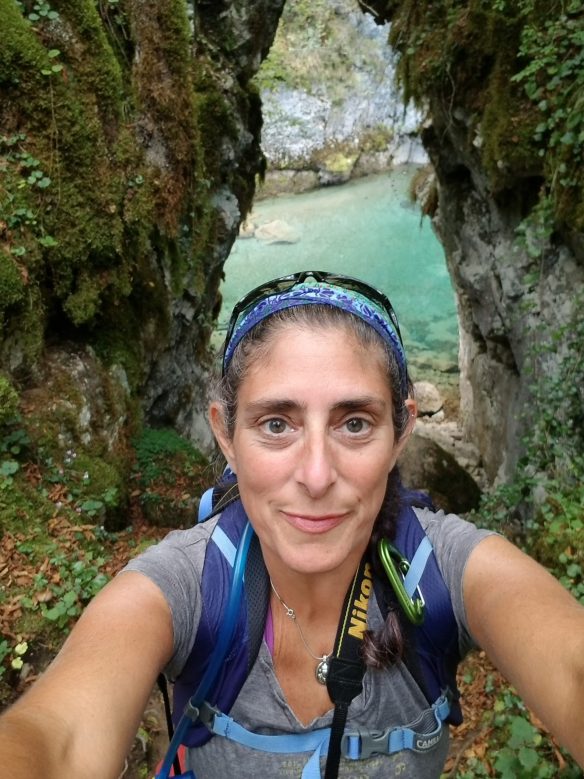
Another late reservation thanks to international data roaming, and we were off to find a guesthouse in the hills of Kolasin, strategically chosen so we could hike Biogradska Gora in the morning.

The guesthouse owner points us in the direction of Restauran Vodenica, a local place famous for its regional specialties, so we try the kačamak, a potato and cheese dish (this region’s answer to mac and cheese), and cicvara, its partner-in-crime, a polenta and cheese indulgence. We top this off with a local red (pas mal) and wobble back to the guesthouse to crash.

Local specialities served with a pot of “sour milk” (handmade yogurt) on the side. This goes on top of the other stuff. Because, you know, one can never have enough dairy products in one dish. The knives are merely garnish…one barely needs teeth to eat this.

It’s on to Biogradska Gora, and the trail at least 2 locals have professed as the best in the park. I’ll wax poetic about pristine mountain trails, exquisite views and luscious canyon floors. But if I’m honest, the 14+ km slog up a gravel road to a lovely but not fantastic view was not my favourite of the trip thus far. The tea at a trailside farm, with local med (honey) to soothe a creeping cold, did help improve the mood tho.

After tea, we find the trail, finish the hike (shortcuts, yay!), and line up another last-minute guest house. It feels as if we’ve gone 412kms, tho the tally was more like 24, and the only thing I’m looking forward to at this moment in my existence is a hot shower and a comfortable bed in our next stop, a country chalet.

…At which point we reach the Tara Riverside. What they’ve failed to advertise is that the river is alongside the busy local road, and that the chalets are something more like IKEA kit cabins. Too shattered to protest (and, really, for 25€ a night, can one?), we partake in the folly and revel in a tepid shower (the intricate details of which I’ll spare: suffice to say it included a hand-held showerhead and no actual shower enclosure; oddly reminiscent of showering on a boat, or a weird roadside cabin in the middle of nowhere…). We indulge in the local fare for dinner, crash, and high-tail it to Tara Canyon in the morning, wending our way up the switchbacking, windy, foggy roads. Not the way I’d hoped to wake up on C’s birthday, but it is memorable if nothing else.

Next stop: Birthday adventures in Tara Canyon and Durmitor National Park.


Read the other Balkan Doživljaj installments: Part I | Part II

The Balkan Doživljaj Part II: Up (and up. and up.) into the Mountains of Montenegro

[Read Part I here!]

Having escaped the throngs, we catch a local bus to take us to the main bus terminal to catch a fancier bus to take us to the airport to get the rental car we’ve hired to get us from points A to Z (and several others, like B, K, S, L, O and D*), and back to again in a week… it’s like a series of semi-strategic moves as we shuttle ourselves to the next square in the game of What’s Next!?

Car, check! Green card that clears us to move freely in and out of the surrounding borders, check! Snacks, check! And they’re off!

A colleague of mine whose family is from this area had told me that crossing the border into Montenegro is like going back in time 10-15 years. As we wend our way towards Kotor, over the border and through the (hills, villages and gorgeous seaside vistas), I’m reminded of his words as we pass through villages that look as if they’ve been bodged-together from scraps of Soviet-era block housing, brick, medieval limestone, corrugated metal and palm fronds (in not necessarily that order or quantity). Interspersed in the weird architecture are ancient palazzos, churches and other structures, each (IMHO) warranting its own page in Lonely Planet. Kotor is nestled in a rocky, fjord-like bay**; a limestone mountain backdrop springing majestically from the sea. The photos do not even do it justice.

Never mind the cruise ships… Kotor is still much more likeable than Dubrovnik

And it’s bustling. Kotor has become both a cruise ship destination and something of a smaller, sweeter Dubrovnik to the south. Because we’ve raced a cruise ship here (and there’s another already in port) we’ve decided to wander around the old town, climb up to the top of the fortress, and find lodging on the outskirts of town to avoid the bustle (and the congestion) in the morning.

The old town is a pleasant surprise: its narrow, labyrinthine streets, now a familiar folly from a few days in Dubrovnik, are softer and warmer and much more inviting than those to the north. Venetian lions flank every gate, many a corner and a few fountains dotted throughout the town. So we wander the alleys, marvel at the cats of Kotor (there are hundreds, perhaps thousands here – there is even a Cats of Kotor museum down one of these narrow streets) and bask in the Mediterranean sunshine.

Kotor’s fortress was built into the near-vertical limestone foothills of Mt. Lovćen (which we are to hike tomorrow), and it, too, is a UNESCO World Heritage Site (actually, two: it’s part of the Natural and Cultuo-Historic Region of Kotor as well as the Venetian Works of Defence between the 16th and 17th Centuries). The town itself dates back to Ancient Roman times (Montenegro was part of Dalmatia too), and while the original fortress on the hill was built by the Illyrians c. the 5th Century, the fortress of Sveti Ivan (the one that stands there now), was built some 1000 years later. To get to the top, you first have to navigate to a back corner of the old city, find the guy at the entry gate and pay a fee to enter the city walls (NB: the book said 3€, we paid 8€; we couldn’t determine whether the fee had gone up or the toll-taker was making a side-living fleecing tourists). From there, you begin the climb. To the top, it’s roughly 1200 metres, or approx. 1350 steps.

Did I mention that it’s quite steep?

These city walls are higher than Dubrovnik’s, and perhaps this has kept out the nouveau-posh cafés and trinket shops besmirching its character. But along the way, there are a couple of old men selling water from a bucket and snacks from a blanket laid out on the old stones. Here, it just fits. We’ve come prepared (with water and trail food, but perhaps not expecting the day’s heat: it’s 25 and there’s not a cloud in the sky!), so we slog upwards past the Church of Our Lady of Remedy, noted for reportedly curing plague victims in the 1500s (also noted as the cover shot on Lonely Planet: Montenegro). The trail then continues up to the top, where, from his fortress, the spirit of Sveti Ivan watches over a now-peaceful Kotor.

If my Photoshop skills were better, I’d use them to blot out the two cruise ship-sized eyesores from an otherwise gorgeous view.

An aside about our itinerary: We had a guide book, some websites, and a rough plan of seeing as much of Montenegro (and possibly Albania) as the week permitted. No rules, no reservations, and fingers crossed for access to Wi-Fi so we could secure a place to crash for the night.


The day: simply wonderful, and we had yet to make it to our (first of many) last-minute choice of lodging, a B&B in a restored 16th Century Venetian Palazzo in the (pick one or more adjectives: adorable, charming, romantic, lovely) exquisite seaside town of Perast. We had this tiny town virtually to ourselves, as the cruise ship folk don’t make it here and the regular tourists have mostly gone for the season. The architecture alone in this little gem is worth a night or two. Did I mention that there were loop-holes in the walls of the room?! (I had to look that term up: these are the slits in castle or fortress walls from which guards can shoot arrows). Ours had, of course, been restored as windows (not needed anymore, as the conquering armies are now safely tucked away in their cell-like berths aboard their floating cities).

The views from our B&B were divine, and in our short stay we could feel the different moods of this enthralling village: the nostalgic undertones of the Venetian stone buildings, old and new; the warmth of the sunset reflecting in a flat-calm bay; the whimsical fog dancing with the same at sunrise… this is a place that calls one back.

Morning came too quickly, as I wanted to revel in the understated luxury. I watched the fog play at the water’s surface as the sun warmed the air and morning dawned another perfect day in Montenegro. Today’s first adventure: a hair-raising, panoramic, thrill-ride up Kotor’s back road, a narrow, serpentine, one-lane (2-way) road that winds you up to Mt. Lovćen.

(sped up a tad for dramatic effect)

We arrive at the top unscathed and are rewarded with what Google calls “Best View of Kotor.” The rest of the views are not half bad either. For the effort, C wins all the adventure points for this drive! Had I been behind the wheel, I would have ended up pleading for mercy in a corner of one of the road’s 25 hairpin turns. And that was just the morning’s adventure (there’s also a precious resident stray mutt up here that, for some moments, I consider smuggling home with me).

As it turned out, by driving up the snaky road and following Google Maps into Lovćen National Park, we overshot the trailhead and ended up in a parking lot at the top of the mountain. So we did the hike in reverse, first visiting the mausoleum of Petar Petrovic Njegoš (Montenegro’s own philosopher prince. Ish.), the site situated atop Lovćen’s 2nd highest peak, with its breathtaking views of the valley and surrounding mountains. The day was so clear, we could see into Bosnia. And, who knows…Montenegro is so small that perhaps we could even see into Albania. With these views, I guess they wanted to ensure Petar could look out over his kingdom in the afterlife as well.

Beginning with the hike down the 461 steps we had already hiked up, we found a rocky trail that led to dry, grassy fields, and came out on a local road in a mountain village that was quite obviously taking a deep breath after its busy summer season. So we had the outdoor restaurant virtually to ourselves, where we lunched in style on local cheeses and Montenegran salad. They present salad here in sort-of an “assemble-your-own” format, so each meal has been an interactive experience thus far. The local cheese, sir, is divine; the air, fresh; the travellers, sated. And the travellers push on, back towards the top, but not before missing a cue on the trail, ending up back at the park ranger’s station and having to walk along the road we rode in, then meeting back up with the trail a few kms ahead.

All in all, another stellar day. Montenegro is looking like a winner already.

Tomorrow’s adventure: Budva (the Russian Riviera of the Balkans) and into the National Parks of central Montenegro. Yay!


*Budva, Kotor, Skadar, Lovćen, Ostrog and Durmitor to name a few…

**while it looks like a fjord, Kotor (like Sydney Harbour and many more like Kotor up and down the European coastlines) is actually a ria, or a drowned river valley that remains open to the sea.

Read more… Part I: Arrival and a Much-Needed Holiday

The Balkan Doživljaj*: Part I (arrival, and a much-needed holiday)

Preface: I had not taken a proper holiday all year. Months of 50+ hour weeks were grating on this wanderer’s spirit. I had planned literally NOTHING for the trip, save a B&B for the first and last days. I had not read the guidebooks. I had not figured out what one does in Croatia or Montenegro or Bosnia and Herzegovina for that matter. But I was on a plane, headed for the Balkans.


Part I: Dubrovnik

I arrive, late and groggy, and foggy from the long flight. Warm sea air and fortress walls welcome me to a new place I’ve read near-nothing about due to a near-overflowing plate of things to do back at home. All work and virtually no play for months make this a much-welcomed holiday (NB: as I begin to write, I am 9 days into a 17-day holiday and have not as yet looked at my work email or read any news.).

I sat and contemplated the upcoming 2 weeks, toes dangling in an aquamarine Adriatic on an unseasonably warm October afternoon, thinking and so it begins:

The B&B here in Dubrovnik is the only place I’ve booked for the trip, and the only “known” knowns at this stage of the adventure are these: my feet are on the ground, there is an old walled city to be explored, and my co-adventurer will arrive at 2100 tomorrow. I am the least-prepared for any trip I have ever taken.

Also, I have never read or watched Game of Thrones. This, I mention, because from the throngs of tourists on GOT tours throughout the city, it’s disturbingly clear that these filming locations were the show-stoppers, and ensuring proper selfie angles were more the goal, than admiring Dubrovnik’s centuries-old and history-rich walls and streets and architectural marvels.

First, Dubrovnik Old Town is gorgeous. Its marble streets are stunning, and the fairytale-esque fortress walls certainly seem less daunting in peacetime than when they were erected – outdoor cafés and gelato shops certainly help. Registered as a UNESCO World Heritage Site, the old city’s fortress walls were built in the 9th Century, re-fortified in the 14th Century, and even further strengthened in the 15th Century. What they hadn’t figured out then was how to protect themselves from a 1667 earthquake that demolished the city, and the 1991 onslaught by the Serbs (ditto). Speaking to any native Dubrovnik-ite, one gets the clear message that the signage throughout the old city about the Homeland War and especially the attack on Dubrovnik in 1991 is there to remind visitors that while GOT is a fantasy world, theirs is an everyday reality. Even 28 years later.

No other metaphor is nearly as apropos: playing something like a Game of Throngs, we walked the old city’s streets and tallied countless steps through the alleys and fortress walls (little did we know that this was only a mere taste of what was to come in the days that followed!), we found what locals consider the best gelato in the city (Peppino’s), the best spot for watching the sunset (atop Mt. Srđ), a quiet place to (cat) nap by the sea, and so many charming little hidden alleys with cats galore.

But 2 days in Dubrovnik is more than plenty, so it was time to move on. Next stop: Montenegro. Kotor first; then, as they say, we’ll figure it out.


*Doživljaj (Croatian/Serbian/Montenegran/Bosnian): n. experience, adventure. NB: I discover that they are not big on vowels here and that many words I’ve tried to pronounce have me sounding like a drunk muppet. Naprijed!

[Click Here to read Part II]

Rome, Part IV: Holy extortion, Batman…Is it time for lunch?

Read from the beginning: [Rome, Part I] [Rome, Part II] [Rome, Part III]

Day 5: So we set out early today, and walk the familiar streets across the Forum, over the river and through the…Not Throngs! We arrive at the Vatican before 9am and are greeted by an early morning glow in St. Peter’s Square. It’s so much more peaceful here without the hordes, where you can actually see the square. But it’s a strategic decision, because one cannot get to the Vatican Museum (and Sistine Chapel) directly from the Basilica, so it was a choice to either start here or there and then stand in line for the other.

The cathedral is spectacular: it’s an opulent display of the Church’s wealth and stature, and the artwork is stunning even to this heathen’s eyes (involuntarily hoping I won’t burst into flames in the center of the room; that would be both messy and embarrassing, and my companion would not be amused. Or maybe he would 😉).

There’s an admission fee to get in to see the Basilica’s Duomo, which feels inherently wrong to me. A devotee to what is essentially the best-funded religious organisation on the planet makes a pilgrimage to the Holy See and still has to pay to see all of it. Fact: you can pay 2€ less if you “walk” (it’s 500 steep, narrow, windy marble steps; you save 100 steps per € or so if you ride the elevator part-way up). Another fact: it was designed by Michelangelo, who had a hand in a lot of the artwork here, the Pietà and the walls and ceiling of the Sistine Chapel for starters.

I’m a visitor, and not remotely Catholic, so I don’t exactly mind the fee, but there are a thousand other churches in Rome, some equally beautiful, that one can just wander into without a queue or the purchase of an E ticket. That said, the view from the top is stunning: you can see the entire city on this crisp, clear morning.

Next stop: the Vatican Museum. It’s barely 10:30 when we arrive, and the line is already around the corner. So the choice becomes whether to wait the 2+ hours in the queue or pay one of the hustlers on the street for a “skip the line” pass and walk in. We cave to temptation and are shuffled, first to the ticket office, then to the front of the line (to get to the other line to enter the museum). It all seems like a grand scheme to extort € from tourists, but this being our last full day, we don’t want to spend it waiting. Until we get inside and realise we’re packed into the halls, surrounded by tour groups from a multitude of lands, each guide sporting a pom-pom on a stick and shepherding their lot through the galleries. Oh, the imagery.

It is, as they say, what it is: we flow with the crowd through the different halls (Raphael’s Philosophy mural, School of Athens, blows my mind: Aristotle and Plato and a cameo by Raphael himself in vibrant hues – incredibly preserved since the 14th Century!), from here through the tapestry-lined hallways and to the Sistine Chapel. As we wander, it strikes me as ironic that the Church has plastered and painted fig leaves on many of the works.

I had expected a chapel, not a grand ballroom filled wall-to-wall with bodies, necks craned to take in the masterpieces that surround. It’s here I learn that Michelangelo poked a little fun at the Church in painting The Creation of Adam. It turns out that he hid a perfect anatomical model of the human brain in plain sight in this painting.

After the Sistine Chapel, the crowds seem to thin. The map room is amazing, as are the little sculptures and artifacts that dot the halls. The stairway itself is a work of art. We exit into the blue-skied Roman day, satisfied that our ransom was (mostly) worth the price.

All that art-gazing makes a tourist hungry. So it’s to another landmark of sorts: the birthplace of fettuccine Alfredo. On an unobtrusive side street sits Alfredo alla Scrofa who claim to have invented the iconic dish. We sit, order, then heed the waiter’s instructions to eat it hot! This is some of the best pasta I’ve ever had…it does not disappoint!

We wend our way back towards the Forum, passing by the Pantheon again (and into, this time). It is only after-the-fact that I learn that one of the statues inside is an early Michelangelo (Christ the Redeemer), sans foule, sans admission fee, at eye-level! This city is incredible.

We’d planned to take in the late afternoon atop Palatine Hill. But it can’t be accessed without a ticket, which for some reason entails waiting in the obscene line for the Colosseum (or paying another ransom); so instead, we take a suggestion from a friend and walk up to the Piazza Caffarelli, and admire the views over the Teatro Marcello and Portico di Ottavia, and towards the 12 other palaces that dot the skyline in that direction…their domes magical in the golden light.

Quick trips have a way of leaving you wanting more. And this Eternal City escape is no different. We walked more than two marathons this week and saw dozens and dozens (if not hundreds) of centuries-old wonders, ate fantastic food and drank local wine. My head hits the pillow this last night, prosecco-filled dreams of Roman gods and cobbled ways.


Epilogue: Homeward, revelations, intentions, Rome-ance…

The tip of Corsica as we leave…

I sit, stuffed into a window seat, on a chatty day flight home through Philadelphia. I’m already cringing at the loud, sharp, nasal ‘Merkin accents that abound, and think about the New Year’s Eve conversation about goals and intentions.

There’s the writing: publish the damn thing already. And the travelling: whale sharks and mantas and lemurs (and of course the elephants), far-flung forests and daunting peaks are all calling. And the living: it’s time to figure out where I fit, and on what continent. Big shifts happen about every 7 years, so it’s time…and so we’ll see.

A friend asked me if Rome was Rome-antic. I ponder this, having spent the week here with a human who sits firmly in my heart. Sure, there are long-stemmed roses on offer and cobbled-street strolls and prosecco toasts and the effect of the city’s magical light. The word romance comes from (the Old French romanz which comes from) the Latin romanicus, which, of course, means Roman. But Rome is a city built of passion and hubris. The heart leading the head (and body) into battle for Empirical supremacy, its buildings erected in fervent tribute to the Pagan gods and Roman leaders who were exulted as gods, said edifices desecrated and re-dedicated to those that served the hearts (and bellies) of the people over the millennia. Art is love, and this city is swathed in it. We see tributes to Jupiter and Juno, Minerva, Neptune and Venus, dotting the Piazzi and adorning the bridges over the Tiber. The river itself is named for the god Tibernius, credited with finding Romulus and Remus, whose story is where myth borrows magic and becomes history. We see temples to Roman gods turned into Christian places of worship, layering historical fact and folklore upon architectural wonders. Myths and legends, these stories weave their way from the heart to the head and to the hands and bodies of Romans who carved chronicles of their gods and Emperors and war heroes in marble throughout the city, preserving them eternally in the fountains and structures across Rome.

So, yes.

The Eternal City only stays as such if it is held in the heart. The heart only stays true if you choose it over the head and the body.


Read from the beginning: [Rome, Part I] [Rome, Part II] [Rome, Part III]

When in Rome: Part III, Traversing Trastevere and unsung Roman wonders

Day 4: The next morn, we set out for (quite literally) the bowels of the city. Atlas Obscura had pointed us (albeit vaguely) towards what is one of the oldest sewer systems in the world. Turns out, in the 6th Century BC, the Cloaca Maxima was how they (also literally) drained the swamp that was to be the grounds of the Roman Forum, and C was keen on seeing this engineering marvel. We followed squidgy directions, and finally, over bridges and down lesser-used stone stairways, found what amounted to a hole in a hole in the banks of the river, next to which was someone’s makeshift camp. On the bright side, the detour took us past the weirdly popular Mouth of Truth (say a lie in its presence and it will bite your hand off), and also enabled us to see the Tiber from a different perspective, taking us to a part of the city that didn’t have throngs of people milling about and queuing up to see just about anything.

View from below, as it were…

Over the bridge and through the charming quarter of Trastevere, with its vine-clad buildings and the narrow, cobbled streets I adore. This is the way I like to see a city, wandering without a specific agenda and bumping into authentic local wonders.

There’s poetry and tragedy and comic relief plastered throughout the city in its street art. And we stumble upon an old church that incorporated ancient Roman graffiti into its façade. It’s little marvels like this that impress me as much as the one we would stand in queue for the following day.

During this day of wandering, we come upon the Palazzo Spada, an almost nondescript palace tucked into an unobtrusive side street, where we encounter a small wonder called Borromini’s Perspective. We walk into a courtyard (the sculptures of which are a wonder in their own right), which contains a window to an optical illusion – a corridor has been built, at the end of which stands a statue. The statue is a mere 60cm (or 2’) tall, and the corridor is a mere 8metres long. By the magic of mathematics and architecture, the perspective looks like a regal gallery many metres longer…the distance between me and the couple in the photo below is in fact greater than the distance between them and the statue.

From here, we return to the Forum, where we’d hoped to get a sunset view from Palatine Hill. Little did we know that only a fraction of the hill was accessible sans billet, as it were, and that the rest of the site closed at 3:30 – a good hour and a half before sunset. Another place added to the next day’s itinerary.

Skirting the crowds, we find a spot to gain some perspective from above and it’s here that we stop to marvel at the site (sic) of so many structures that formed the center of ancient Rome; the Colosseum, perhaps the most famous structure in this now-modern city, is but a tiny dot in the background.

I can see how one becomes inured to these wonders, and how easy it would be to take for granted these things, though magical and important to new eyes, they can become near-boring on one’s daily run to the store for milk and bread.

And life is like that, I think, as we toast with (massive!) flutes of limoncello to the marvels around us, the majestic Colosseum quietly looming across the way and chatty Italian millennials snapchatting and tittering at the table behind us. We see what we take time to observe, we undervalue what is easily at our fingertips, only maybe revelling in gratitude upon reflection.


We’ve wandered more than a half-marathon’s worth of steps today and the cobblestones seem to wobble more on this walk back to the B&B (it could, perhaps, have been the limoncello), the Colosseum seems to glow brighter, the crisp Roman night seems to embrace us as we wander through the Forum, clip-clop of horse-drawn chariots (erm, carriages) resonating in the night.

Tomorrow, we visit The Vatican.

Read more When in Rome: [Rome, Part I] [Rome, Part II]