
Once upon a time, when the line between myth and history was even thinner than today, there was a tree called Yggdrasil, the World Tree. Nordic myth tells us that Yggdrasil was the nucleus that connected the 9 worlds: the world of the humans (Midgard) and those worlds of the two tribes of Norse gods (Asgard and Vanaheim), the world of the giants (Jotunheim), the primordial worlds of fire (Muspelheim) and ice (Niflheim), the worlds of Alfheim (elves) and Svartalfheim (dwarves), and Hel (well…).
Yggdrasil’s roots held the underworld down, and kept Midgard (land of mere mortals) at a neutral place, where prankster-gods like Loki couldn’t cause (as much) mischief from his perch on the upper Asgardian branches. That said, according to legend, he did his fair share. Yggdrasil was the home to myriad woodland creatures and a dragon, and was the epicenter of woodland resources. I paraphrase (and probably get some of it wrong), but if Yggdrasil were to fall, this would signal the end of days.
Oh, the irony.
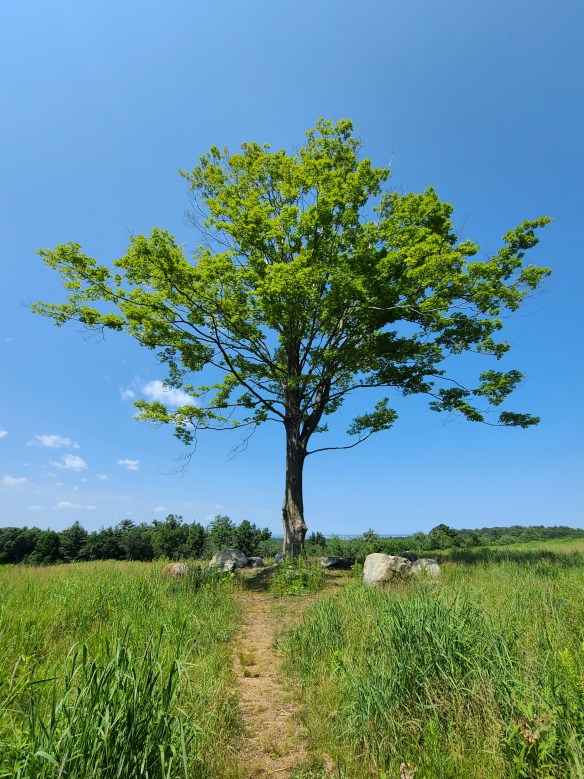
So yesterday, when I wandered along a new trail and came out of the forest into a meadow on a hilltop, where this gleaming green giant simultaneously welcomed one into, graced, and held dominion over the space, I was awed. Yggdrasil is merely a symbol, of course, because gods and dwarfs and elves and giants don’t really exist. But the World Tree, whose roots tether the real world in all its fragility to the stories, and reach down into the well of Mimir, whose waters hold the depths of knowledge (sought by Odin for which he sacrificed an eye, but that’s another story), stands tall and solid and proud nonetheless.
Trees hold the keys to the wisdom of the land. One must be kind to nature (or trade an eye?) to drink from its well. But, I digress…
Norse Mythology is especially fascinating to me because if you look at it in parallel to the other polytheistic belief systems and their pantheon of gods and goddesses (Hindu, Greek, Roman, etc.), there are striking connections between their symbols and stories and philosophies, yet the Scandinavian relationship with the natural world is much more deeply-pronounced, as evidenced in their folklore (of which I’ve barely scratched the surface!).
I’m spending more time on local trails in these dragging Corona months, hunting egrets for marshy photoshoots, seeking refuge in quiet, wilder spaces (nearby, with safe social distancing and the fewer people the better); escaping the trappings of Zoom meetings and over-blocked Outlook calendars, daydreaming of the day I can hop a flight and head East. If I’m honest, where is of less concern to me right now than when.
But before I wander down a forest path and get lost in a macramé of Indra and Zeus and Thor and Jupiter, I’ll come back to my quiet present, walking these trails with flamboyant ancient characters spinning their stories in my mind, blue skies holding any thunderstorms at bay. Thanks to Surya or Freyr or Ra or Apollo or Sol for the skies on this brilliant afternoon!
So before me stands Yggdrasil, or a simple Oak (or beech or ??) standing tall, surrounded by a ring of boulders. Mind wanders to covens or whatever the collective noun is for philosophers, scholars, arborists, students or, like me, curious photographers that have stumbled upon this wonder… The tree, and its empty auditorium, stands in a meadow whose ridge overlooks the overbuilt town below. The clear day enables me to see beyond the rooftops towards the sandy shores of Plum Island, and from there, out to the Atlantic, only a few miles away as the osprey flies.
I sit in the embrace of Yggdrasil’s shade for minutes, or maybe half an hour, contemplating what, I can’t now remember. But the shriek of a quite small but very insistent human (read: petulant) refusing to move any further “or else” jolts me out of my quiet reverie and back into the real world of he who yells loudest gets the snacks. I get a “he does this all the time” look from the mother and Damien gets rewarded in the form of a juice box and cheese crackers, the bright orange ones whose cello packaging I often see littering the beach. Practice is stopping there: you don’t know her circumstances, I remind myself, and wish them happy trails as I traipse onwards.
I look to the tree as if it could understand my dismay with the world as it is, envisioning the irony of a tree offering a hug to a human, understanding its precarious footing these days.
The birdsong resumes, as does my walk. I spot a scarlet tanager, a fleeting flicker of blood-red in the lush green treetops, and I remind myself to log these outings as I do each of my dives. When we log experiences, we are less likely to take them for granted, I suspect.


I end the day with egrets and an oriole (or was it an American redstart?) and big toads and slithery garter snakes; even a curious white-tailed deer who looked on, perhaps even entertained, as I was assaulted by greenheads (note to self: leap year or non, these f*ckers are always on time).
And there it is: another Day ticked. In the logbook of my mind, I note that as with the now-waning light, we are entering into the spring of the last half of this famously infamous year. I’ll look to the gods of humility and patience and tolerance and forgiveness and humour to guide me through these next trees.


 We had seen the rocky mound of an island from land, its sole palm reaching for the sky as if trying to escape Poseidon’s wrath. Ave Maria, it’s called; there’s no use attempting to mix metaphors here. This is our first dive site.


 The next day’s dives are similar to the first, with a parallel state of corals and ditto sea critters. They are nice dives with fun swim-thrus and more interesting granite structures than the previous day, sea flora painting the rock its underwater patina. This being a nice but unimpressive dive overall, I was not prepared for what we saw next. As we exited a swim-thru and rounded a corner, a massive, majestic, magnificent marbled ray defied not only the m-adjectives, but my expletives as well, by making itself known. It was nestled between two rocks, flanked by several smaller stingrays, seeking or providing protection, I am not clear. We stayed close, watching their behaviour, the smaller rays coming and going, fawning over the larger in almost a caress; nature never ceasing to amaze. It is at these times I feel fortunate to be a diver, experiencing the undersea world in childlike awe and wonder, as if given special access to explore another planet.


 After a lazy day fending off jetlag, it’s an early airport run to fetch my flight-weary


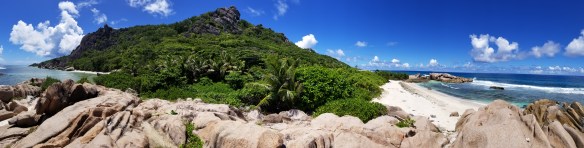 To get here, a pleasant bike ride takes us to the southern end of the island, through a vanilla plantation that rends the air a sweet and salty mix. The path to the beach goes by the park’s tortoise pen; a weird sight really, with dozens of the massive reptiles lazing in the sun and engaging with chattering tourists who feed them leaves and grass in a United Nation’s collection of languages.


