I’m flying on what seems an endless leg, northward and eastward, currently on a trajectory over Russia; a 15-hour slog and reminder of the value of the “priority economy” ticket I declined to purchase. I’m stuck in a window seat, feeling alternately claustrophobic and antsy, two individual snoozing millennials blocking my access to what freedom exists on this sky bus.
In my ear is an audio book, Paul Theroux’s The Great Railway Bazaar. His account of a trip across Asia is significantly more interesting than mine thus far (N.B. it’s one of the best travel books I’ve ever read!!!).
Part 2 of this intro commences as I’m sitting by the pool when dawn breaks. Pigeons intermingled with morning songbirds, a sound one might not expect in this madly bustling city. It’s an oasis of sorts, tho a new LED billboard that blights the rooftop view hints of things to come.
I’ve spent 3 days here in Bangkok, my 2nd visit to this frenetic city. This go-round, I’m able to spend time with my uncle and his gf, who live here part-time. We eat our way through 2 days, wandering a night market (Chokchai), a weekend market (Chatuchak) and a produce market (Or Tor Kor).
After a morning bruising by a local massage doctor (My sore muscles will thank her. I hope.), we make our way to Nonthaburi pier to hire a boat to take us down the river a ways and out to the island of Ko Kret. The Chao Phraya River wends its way through Bangkok. On its banks, a mish-mash of older stilt houses look as if the next big wind might topple them, line-drying laundry and all, into the murky waters. Interspersed with the houses are shrines and temples and giant buddhas and new high-rise buildings, creating a ridiculous waterfront on this river’s banks.
Ko Kret was uninspiring. But we’ve arrived on a non-market day, so maybe it’s that we’re the only tourists there and the island is also unimpressed with our existence and chooses to ignore us as well. We hire bikes, roll along the pathways for an hour, and find our boatman to take us back to the pier.
In the middle of the river, we see flotillas of lily pads, a grand canopy for the massive barb carp, whose jumping makes the water seem to boil. And these lily pads are the perfect fishing spot for herons of all shapes and sizes, especially a beautiful little striated heron, who I hadn’t realised I caught until after the fact. Even here, a place where steel and concrete seem to spring from the ground as the jungle once did, there is nature to be found. If you look.
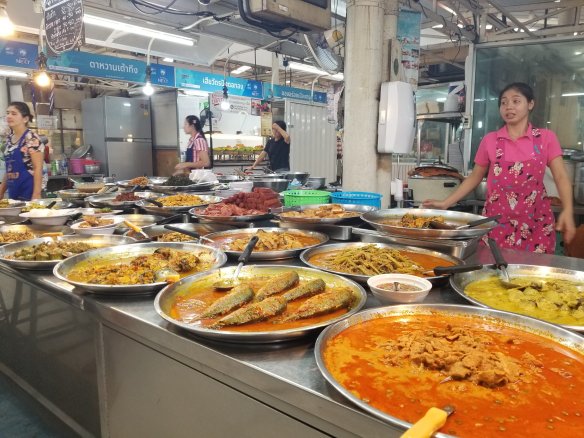
We get back and it’s almost sunset. The pier is buzzing with students and workers on their Monday evening commute. These food stalls have nearly everything you could imagine on offer: fried calamari, taro dumplings, hot dogs on a stick, dried shrimp, mango and sticky rice, grilled whole fish… lumpy stuff I can’t identify, and everything in between!
It’s not a secret that I love foreign markets. Ironically, I hate crowds but I’m strangely drawn to the buzz of these places, the smell of the myriad foods cooking in hot oil or over an open fire, the almost rhythmic flow of people and traffic and tuk tuks and motor scooters, with its own tempo and melody.
It’s with these things in my mind – a happier vision of Bangkok than when I was last here – I fall asleep. The next morning I’m off to Ranong, then to the Myeik Archipelago, to get my feet wet again, as it were. It’s a semi-complicated game of hopscotch, visas and border crossings, as I venture North to Burma.
So, Ranong. It’s like a forgotten place, this town: the old, storm-worn buildings, rusted cars and motorbikes and façades, as if stuck waiting for something to happen. There are cafés and shops lining the main street, but no patrons. I arrive mid-day on a Tuesday, expecting to be able to see the ocean or at least hop a bus or get a taxi or tuk tuk to take me somewhere with a view. “Too far” I’m told by the local moto-taxi guys. It’s not really a taxi, but a motorbike with a wagon on the back. A not-quite-tuk-tuk setup that I gather is more for moving people (and stuff) blocks, not kilometres. The hotel is equally helpful. No, there are no taxis. The bus goes near where you want to go but not at this time of day (it’s 3pm). There is no beach. Or, there are many beaches, but you can’t get to them because they are far. There are no scooters to rent. But you can rent a motorbike. Which is great, except I don’t want to die in this wretched place. I decline. At dinner, I was apparently too white to qualify to eat spicy food, and was thus served the bland version. Thus, my request for chili sauce was met with equal parts confusion and animosity.
Ranong.
I give Ranong a walloping thumbs down. It is, I gather, a stopping point for ex-pats on visa runs, or travellers, like me, in-between segments of a journey.
This greeted me at the hotel…A quiet morning dawns over the Rattanarangsan Palace.
Preface: I had not taken a proper holiday all year. Months of 50+ hour weeks were grating on this wanderer’s spirit. I had planned literally NOTHING for the trip, save a B&B for the first and last days. I had not read the guidebooks. I had not figured out what one does in Croatia or Montenegro or Bosnia and Herzegovina for that matter. But I was on a plane, headed for the Balkans.
Part I: Dubrovnik
I arrive, late and groggy, and foggy from the long flight. Warm sea air and fortress walls welcome me to a new place I’ve read near-nothing about due to a near-overflowing plate of things to do back at home. All work and virtually no play for months make this a much-welcomed holiday (NB: as I begin to write, I am 9 days into a 17-day holiday and have not as yet looked at my work email or read any news.).
I sat and contemplated the upcoming 2 weeks, toes dangling in an aquamarine Adriatic on an unseasonably warm October afternoon, thinking and so it begins:
The B&B here in Dubrovnik is the only place I’ve booked for the trip, and the only “known” knowns at this stage of the adventure are these: my feet are on the ground, there is an old walled city to be explored, and my co-adventurer will arrive at 2100 tomorrow. I am the least-prepared for any trip I have ever taken.
Also, I have never read or watched Game of Thrones. This, I mention, because from the throngs of tourists on GOT tours throughout the city, it’s disturbingly clear that these filming locations were the show-stoppers, and ensuring proper selfie angles were more the goal, than admiring Dubrovnik’s centuries-old and history-rich walls and streets and architectural marvels.
We arrived on a weekend where there were no cruise ships in port. We did not yet fully-understand how fortunate we were.
First, Dubrovnik Old Town is gorgeous. Its marble streets are stunning, and the fairytale-esque fortress walls certainly seem less daunting in peacetime than when they were erected – outdoor cafés and gelato shops certainly help. Registered as a UNESCO World Heritage Site, the old city’s fortress walls were built in the 9th Century, re-fortified in the 14th Century, and even further strengthened in the 15th Century. What they hadn’t figured out then was how to protect themselves from a 1667 earthquake that demolished the city, and the 1991 onslaught by the Serbs (ditto). Speaking to any native Dubrovnik-ite, one gets the clear message that the signage throughout the old city about the Homeland War and especially the attack on Dubrovnik in 1991 is there to remind visitors that while GOT is a fantasy world, theirs is an everyday reality. Even 28 years later.
Did I mention that Dubrovnik is gorgeous?
No other metaphor is nearly as apropos: playing something like a Game of Throngs, we walked the old city’s streets and tallied countless steps through the alleys and fortress walls (little did we know that this was only a mere taste of what was to come in the days that followed!), we found what locals consider the best gelato in the city (Peppino’s), the best spot for watching the sunset (atop Mt. Srđ), a quiet place to (cat) nap by the sea, and so many charming little hidden alleys with cats galore.
Gelato. Sunsets. A perfect spot for a dip (just around the corner…).
But 2 days in Dubrovnik is more than plenty, so it was time to move on. Next stop: Montenegro. Kotor first; then, as they say, we’ll figure it out.
*Doživljaj (Croatian/Serbian/Montenegran/Bosnian): n. experience, adventure. NB: I discover that they are not big on vowels here and that many words I’ve tried to pronounce have me sounding like a drunk muppet. Naprijed!
Day 4: The next morn, we set out for (quite literally) the bowels of the city. Atlas Obscura had pointed us (albeit vaguely) towards what is one of the oldest sewer systems in the world. Turns out, in the 6th Century BC, the Cloaca Maxima was how they (also literally) drained the swamp that was to be the grounds of the Roman Forum, and C was keen on seeing this engineering marvel. We followed squidgy directions, and finally, over bridges and down lesser-used stone stairways, found what amounted to a hole in a hole in the banks of the river, next to which was someone’s makeshift camp. On the bright side, the detour took us past the weirdly popular Mouth of Truth (say a lie in its presence and it will bite your hand off), and also enabled us to see the Tiber from a different perspective, taking us to a part of the city that didn’t have throngs of people milling about and queuing up to see just about anything.
View from below, as it were…
Over the bridge and through the charming quarter of
Trastevere, with its vine-clad buildings and the narrow, cobbled streets I adore.
This is the way I like to see a city, wandering without a specific agenda and
bumping into authentic local wonders.
There’s poetry and tragedy and comic relief plastered throughout the city in its street art. And we stumble upon an old church that incorporated ancient Roman graffiti into its façade. It’s little marvels like this that impress me as much as the one we would stand in queue for the following day.
During this day of wandering, we come upon the Palazzo Spada, an almost nondescript palace tucked into an unobtrusive side street, where we encounter a small wonder called Borromini’s Perspective. We walk into a courtyard (the sculptures of which are a wonder in their own right), which contains a window to an optical illusion – a corridor has been built, at the end of which stands a statue. The statue is a mere 60cm (or 2’) tall, and the corridor is a mere 8metres long. By the magic of mathematics and architecture, the perspective looks like a regal gallery many metres longer…the distance between me and the couple in the photo below is in fact greater than the distance between them and the statue.
From here, we return to the Forum, where we’d hoped to get a
sunset view from Palatine Hill. Little did we know that only a fraction of the
hill was accessible sans billet, as
it were, and that the rest of the site closed at 3:30 – a good hour and a half
before sunset. Another place added to the next day’s itinerary.
Skirting the crowds, we find a spot to gain some perspective from above and it’s here that we stop to marvel at the site (sic) of so many structures that formed the center of ancient Rome; the Colosseum, perhaps the most famous structure in this now-modern city, is but a tiny dot in the background.
I can see how one becomes inured to these wonders, and how easy it would be to take for granted these things, though magical and important to new eyes, they can become near-boring on one’s daily run to the store for milk and bread.
And life is like that, I think, as we toast with (massive!) flutes of limoncello to the marvels around us, the majestic Colosseum quietly looming across the way and chatty Italian millennials snapchatting and tittering at the table behind us. We see what we take time to observe, we undervalue what is easily at our fingertips, only maybe revelling in gratitude upon reflection.
We’ve wandered more than a half-marathon’s worth of steps today and the cobblestones seem to wobble more on this walk back to the B&B (it could, perhaps, have been the limoncello), the Colosseum seems to glow brighter, the crisp Roman night seems to embrace us as we wander through the Forum, clip-clop of horse-drawn chariots (erm, carriages) resonating in the night.
Day 1: Arrival and the beginning of a mini-adventure, in which I meander from Termini (station) to Forum (B&B), arrive in awe of the sheer magnitude of the architecture, and wander about the crowded streets that divide the Fora and lead the throngs to and from the Colosseum.
The evening before, I had boarded a British Airways 747, my frequent flyer miles and some manipulation of schedules landing me in a Business Class seat. A multi-pronged luxury it was, as the past 3 months had been a whirlwind of work and little sleep, resulting in an unintentional avoidance of adulting, and a lack of attention to detail on the home front. When you get home, you’ll have to deal with it all, a somewhat-envious inner voice reminds. That noted, I feel only a bit guilty at the indulgence and glad to leave the gray December New England skies behind if only for a few days.
I arrive groggy, from both a short night’s sleep and more than enough vino plied by the nice airline folk. A Roman day with its crisp and clear blue sky greets me, tho; the relative warmth already seeping into my pores.
Arrival is always a little overwhelming; not knowing the way, the landmarks, the language… It’s mid-afternoon on New Year’s Eve eve, my first time in Rome and I’m still semi-embarrassed because it’s a rather frivolous way to end one year and herald in the next. I’m here a day early to shake jetlag and get my sea legs before I meet my co-hedonist. I navigate the uneven Roman streets from Termini station towards my B&B, thankful for Google Maps to guide me because I’m too frugal (read: aghast) to pay the 60€ for a car from the airport. This is a marginally longer commute, but I rather like walking and it’s a nice way to get immediately immersed in a new place on arrival.
I’ve been warned enough of the pickpockets here from the travel blogs I’ve read and all the signage everywhere… Is it such a rampant problem, I wonder, or are they just stoking visitors’ anxiety around being in a Foreign Place? Foreign, being a relative term, as it looks more foreign to me than it actually feels. Decidedly European, I decide on first impression; confirmedly ancient, I then observe, as the Colosseum leaps into view when I turn a corner towards my hotel. There it looms, large and impressive at the end of the via. Another corner, and 3 columns of one of the Fora materialise at the end of the street. Cobbled steps, a fountain (one of hundreds that are scattered throughout the city) flowing with clean, fresh water. 10 more metres and I’m at the B&B, where I see my first ruin up close.
I arrive also
without much of an itinerary, save a map I’ve bodged together to mark recommendations
from friends and sites that look too good to miss. It’s in the spirit of getting the lay of the land that I set
out to wander the neighbourhood to keep occupied and awake enough until proper
bedtime*.
Real first impressions: it’s crowded, where crowded is an understatement. I start the journey a little off-put if I’m honest. I don’t want to spend our precious days here waiting in line alongside tour groups. I chalk up the looming mood to cranky, hungry, tired, travel-weariness. But the sites so far are breathtaking: the Colosseum at dusk, the Foro di Augusto glowing in the evening’s light; the Roman Forum across the way; the 35-metre tall Colonna Traiana, with its comic book-looking depiction of the wars between the Romans and Dacians spiralling up its length; the magnificent Typewriter building, the Altare della Patria, whose imposing stature dwarfs the other wonders in this area.** Non male, as they say, for the first few hours…tomorrow, I explore!
Throngs and wonders, a big dome with a hole in it, a creepy crypt, and things that go ka-boom in the night
Day 2: Before C arrives, I’ve got about 5 hours to see some of the sites I’ve plotted on my map. First, it’s the Pantheon – not to be confused with the Parthenon (Athens) or the Panthéon (Paris)! 😂
Like many monuments, the Pantheon is a former Roman temple that now serves as a church (I take a heathenistic moment to ponder whether there are enough congregants for the astounding number of churches in this city). One of the factoids I’ll learn this week is that the dome of the Pantheon is the world’s largest unreinforced concrete dome. The astounding fact to me, tho, is that it was built in 126AD and still in pristine condition! And as if to out-do all other fountains I’ll see here, the one in the Piazza della Rotunda is a wonder in its own right.
Speaking of fountains: toss a coin over your (left) shoulder (with your right hand) into the Trevi Fountain, and it will ensure a return trip to Rome (more coins assure both romance and marriage). And over 1m € per year are thus tossed. I’ve read that the €s go to the needy. I’m not hard pressed to fling coins, but I’m pressed hard as I squirm my way to the fountain’s edge, disenchanted by the throngs by the time I’m down there.
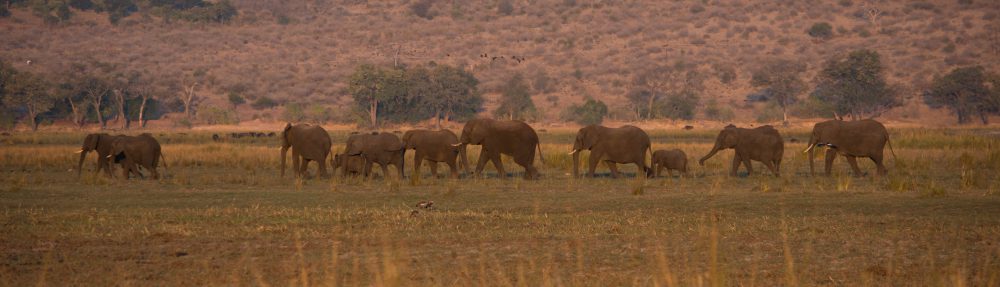
There’s always an elephant…
On the way to the Pantheon, though, I passed a man playing what I surmise is a hammered dulcimer. He’s set up in front of an elephant bearing an obelisk that sits in front a nondescript church. It’s the little wonders, I remind myself, and not necessarily the big attractions that are some of the most memorable.
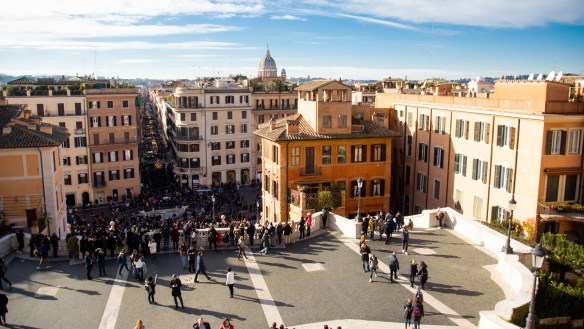
After Trevi, I find I’ve still got time, so I head towards the Spanish Steps (when in Rome…). These 174 steps run from the Bourbon Spanish Embassy to the the Trinità dei Monti church and are the darling of many a famous movie and song. More fountains; ditto, the throngs: it’s because of the latter that one cannot see any actual steps, and for just a moment I wonder if I’ve mis-stepped in coming here.
What steps? But a nice view from the top!
Fleeing the masses, I point my GPS in the direction of an Atlas Obscura oddity: the Santa Maria della Concezione Crypts, or the Crypts of the Capuchin Friars. This ossuary rivals that of the Catacombs in Paris; what it lacks in grandeur it makes up for in creativity. Suffice to say that the artiste took creative liberties in arranging not only the stacks of bones (some 4000 skeletons are (dis)assembled here), but also the various bodies in repose (fully-frocked Friars) and flight (child-sized bodies looking down from the ceiling; skulls with scapula-wings). The walls and ceilings were covered in mandalas and chandeliers, each surface laden with myriad symmetrical designs, all made from individual bones and carefully arranged in gruesome patterns that affected something of a moribund paint-by-number display.
As I wend my way back, I stumble across the We Run Rome road race and flash a 2019 goal to do a 10k (we’ll see!). But first, it’s Pizza for lunch, a trip to a local wine and cheese shop for aperitivo supplies and then back to the B&B to get ready for New Year’s festivities.
Ringing in the New Year, Roman style!
Italians eat dinner late. So an 8:30 dinner is on the early side, but we’ve managed to find some fantastic melanzane parmigiana at a little local place in the piazza near the B&B. New Year’s Eve, thus far: Prosecco and Parmigiana. Next stop, Pyrotechnics.
I’m not a fan of huge crowds or wild New Year’s Eve parties. But since it’s my first in a European city, la Fiesta di Roma is on the docket. It takes place in Circo Massimo (Circus Maximus), the grand sports stadium where they once held chariot races and Ludi, festivals for the gods. In its day, the capacity was 250,000. Tonight, I’d estimate there’s 50,000+ modern Romans. We listen to the weird music, watch the bizarre dance and aerial show (a tribute to the ludi of yore?) and ooh and ahh over the fireworks display over the ruins of the Palatine palace. It may be the most dramatic setting for fireworks I’ve ever seen.
The festival goes for 24 hours, but 2am feels like we’ve been up for a week. We make it long enough to purchase a bottle of bubbly from a street vendor (C’s post-midnight haggling is impressive!) and toast to goals and future adventures.
The finale of the NYE fireworks at Circus Maximus, Rome
*Jet lag avoidance tip #1: when travelling East, stay up as long as possible the day you arrive, so you go to bed at proper local bedtime in an attempt to fool your body into waking up at a moderately human hour the next morn.
**Among other nicknames for the monstrosity are la dentiera (the dentures, in reference to its white marble in stark contrast to its surroundings) and la torta nuziale (the wedding cake).
Iceland is like Sweden’s weird cousin that shows up at all the big holidays. It looks more like the moon or a newly-discovered boiling planet than the other Nordic countries, yet it shares the same ancient gods and speaks some variant of an old mother tongue. It’s intriguing, mysterious, remote, cold and hot (simultaneously)… It’s the one who tells all the cool stories at family gatherings, tales so far-fetched that we’re not sure whether they’re real or not.
It’s roughly the size of Kentucky (or, the size of Ireland and Belgium combined), but with a population smaller than the city of Nice; so once you leave Reykjavik virtually everywhere feels like you’re in the middle of Nowhere. It’s almost like a theme park, divided into regions where the farther from the airport you stray, the more A-tickets you’ll need (Adventure tickets, that is…).
One corner looks like a troll nursery, while another, a boiling cauldron ready to burst its seams and spew scalding water or lava or unicorn entrails… one never knows.
I’ve been curious about this strange place, and I’m known to take a photograph or two (or 642) when I travel, so I made plans for a 3-day stopover here on my way back from Sweden, taking advantage of Icelandair’s #MyStopover promotion, where they don’t charge you extra to add days to your ticket when you fly through Reykjavik. You do, however, get to pay for your hotel, rental car and anything you do or eat while you’re here. One thing to note: Iceland is not cheap. On the plus-side, most of the things to do are outdoors, and for the most part, free (unless you do a tour).
So I land in the land of fire and ice, acquire my rental car (another note: you need 11 different types of insurance to cover the land/air/sea hazards that may or may not occur while driving in this place), and I’m off: first stop the Snæfellsnes peninsula, which I’ve nicknamed Snuffleupagus because it’s only just moderately easier to pronounce, to see mountains and waterfalls and old churches and fantastic coastlines.
My first observation: there are no trees here. But: black mountains and weird green rolling hills pop up from flat expanses, appearing out of the fog like they’ve just sprung from the depths of some grim faery tale. It’s like Kansas meets Mars or the Moon, in black (and green) and gray, but there are still literally no trees, just a smattering of what looks like wheatgrass and moss-covered boulder fields. And rainbows appear on a moment’s notice, since it’s drizzling then sunny…not terribly unlike New England weather. But with ink-black earth. And volcanoes. And maybe trolls.
About an hour outside of Reykjavik, wending my way north and west, I encounter a tunnel*. Only later do I find out that it is called the Hvalfjarðargöng, and only when I’m 1 or 2km in, do I realise it’s the longest tunnel I’ve ever driven (nearly 6km long and 165 metres deep), rock-lined and sloping steeply (8%!) to enable travel beneath the Hvalfjarður fjord. It’s as I resurface here that I behold the first of many Icelandic rainbows I’ll see in the following days.
The hotel is the only thing lit in the little town of Hellnar when I arrive. And by little, I mean there seems only to be the one hotel, a cluster of about 15 clean-cut, brown houses, an old church, a couple of other buildings, maybe another restaurant, and an expanse of coastline. The staff, friendly; the tea, hot; the bed, cosy. I’ve spanned 2500km in a plane and another 230+ kms driving up here in the wild and woolly weather. This flicka is ready for sängen.
I shot on the order of 600 photos in 3 days, beginning that Monday morn. How? When the landscape and the light are otherworldly, and the sky shows a different side every 8 minutes, even a simple snapshot out the window of a hotel room has a mood and a texture like a painting.
So on this new day, when the dreariness looked like it wanted to thwart an entire stopover, I woke up and steeled myself for the worst of elements. At brekkie, though, the clouds broke. For a precious few moments the sun appeared as if it would stay the day… alas, by the time I was ready to embark (a mere 20 minutes later), the skies darkened and Thor reigned (and rained and rained). Undaunted, I set out (rather, there is quite literally NOTHING to do here except look at nature, so I went anyway). First stop: Kirkjufellsfoss.
The road from Hellnar to Kirkjufellsfoss is across the Snæfellsnes peninsula: follow the main road, make a left at the black church “on the corner” and make a right when you see water again. There are few roads here and, it must be stated, they are in very good condition – Iceland even has a website dedicated to road status…the weather here is so changeable that many roads close due to water, mud, snow, ice, etc. at the drop of a hat.
The Kirkjufellsfoss is one of the most-photographed landmarks in Iceland, and my ultimate dream was to capture the Northern Lights here, though I’m doubtful the weather will permit it. I arrive, driving through the small mountains, then along the coast, a drive lined with moss-covered lava fields, dramatic green hills, glacial peaks and an otherwise other-worldly landscape.
Kirkjufell side view
The tour bus and teeming tourists turn me off at first (as do the rain and wind). But the clouds momentarily break, the bus leaves, and I am left with a living photograph before me… The shot, worth it. Then the skies then darken and it begins to hail.
Hailstorm, brief, I set off again, towards the seaside town of Stykkishólmur, situated on the northern side of the Snuffleupagus peninsula. It is quaint, and I climb up to the lighthouse during a break in the showers, rewarded with a view of the bay, rainbow touching down on one of the surrounding islands.
My Snæfellsnes loop continued with a stop at the renowned Búðakirkja, a dark-brown church built in the early 1700’s by a Swedish merchant, torn down and rebuilt (twice!) before the mid-1800’s. It is only made more stunning by its site (mountains on one side, the wild North Atlantic on the other) and the magic Icelandic skies. I continue along that coast, stopping multiple times, gape-mouthed, to photograph the landscape. I vow to put that Nikon 14-24 f2.8 lens on my wishlist.
By midafternoon on that first day, cold and wet were factors by which I had stopped measuring my well-being. The weather began as gray, moved to alternately downpouring and sunny, shifted to gale-force winds (in which, at one point, I had to hold onto my rental car to avoid getting flung off a cliff), hail, more rain, then brooding fog. More sacrifices to the gods of Gore-Tex. The winds, unrelenting! Njörðr (Njord), Norse god of sea and wind, is ever-present. One wonders why this strange place wasn’t called Norway instead.
On Tuesday, I’m slated to stay in the South Coast town of Vik. My plan is to head that way in the morning, stopping along the way when I see things that pique my interest. From Hellnar to Vik is about 360km, the weather only marginally better than the day before.
I stopped to get gas in a small town called Hveragerði, somewhere between Reykjavik and Hell(a)… Turns out it’s a geothermal hotbed here, the hillsides boiling just below the surface, and the continental plates threatening to move farther apart at any moment.
I took a small hike in the town’s geothermal park, met a lovely local woman named Jenny (pronounced “Yenny”) and her dog, and visited their quirky earthquake museum, where I stood in the void between the Eurasian and North American plates.
Iceland, where the earth boils…
…and unicorns thrive
I stand between the European and North American tectonic plates
Just in case the boiling earth wasn’t enough of a deterrent
The earth here, mineral-rich and vibrant in the pre-downpour sunshine, seemed to speak…creaking and bubbling as it sent up its wafts of steam from underground cauldrons. The air, its texture, like silk: smooth and thin and soft. Jenny told me she moved here because the energy was different; that the place somehow called her to stay.
As the sun was getting lower in the sky, I stopped to explore Seljalandsfoss, tourist magnet that it is – it’s one of the waterfall wonders here, and because of the stone’s configuration, you can walk behind it (if you don’t mind getting a tad wet!).
Adventure girl dons all the rain gear in her pack…
Icing on the cake: a rainbow after the rain showers… This is where the unicorns come to party
And again the landscape changes on this part of the island, on one side of the roadway, there’s glacial peaks bounded by dormant volcanoes, on the other there’s flat, black expanses dotted with what looks like meteorites. It’s remnants from the volcano that erupted here in 2010. Nobody can pronounce Eyjafjallajökull, so they just call it “the volcano that mucked up all the flights.” All this lava yields to fertile fields and farms promising horse riding on the celebrated Icelandic ponies. It changes again as the road wends back towards the coastline, with its basalt cliffs and black beaches. And I arrive at a little guest house in Vik for my final night.
Once upon a time there was a volcano whose name we couldn’t pronounce…
My last morning, I spend an hour or two wandering the hills above the town, then out the jetty to view the Reynisdrangar rocks from my perch some 300 metres into the sea. Legend states that the rocks are mischievous trolls, caught in the sunlight and frozen as pillars of jagged rock, after a night of dragging ships to shore.**
Waves crash on Vik’s black sand beach, but not before taking the form of giant polar bear paws…
This is a statue not far from the black sand beach, a tribute to fallen seamen
Behind the volcanoes: the glaciers!
Vik, from the jetty
I drive the way I came, stopping along the route to see what I can in the little time left. As I leave, I reflect that what I’ll remember more than the famous waterfalls, the oft-photographed landmarks, and the tourist-filled hotspots, is the landscape leading to-and-from the wonders.
This is how I spent most of my time outdoors in Iceland…this, and holding onto heavy things to avoid getting flung over cliffs.
NB: I’ve found that the coolest, most amazing experiences I’ve had travelling are the ones not in a guide book, but rather what arises (and surprises) when you least expect it: A trail lined with wild blueberries; cartoon mushrooms popping up from the mossy forest floor; fresh kanelbulle from a local baker; a stranger coming to your aid when you are out of options; a kind local guiding you to the best view in a town you can’t pronounce; deep sleep in an old dirt-floored cabin beside a stream; a paddle down a canal beside an urban island once used as the Royal hunting grounds; a hike through rainbow-coloured steaming earth; a hail storm then a magnificent rainbow on a volcanic coastline in a village with 12 houses…
And so, with a last-minute road closure that diverts traffic over a small mountain on a semi-paved road and gets me to the airport almost an hour later than necessary, I leave these Nordic lands behind, hoping to return again as soon as my interpreter will have me.
A view from our misty, mossy camp along the Berslagsleden…
*Side note: tired from travel and gobsmacked by the scenery, I accidentally got stuck in the EZPass lane (perhaps ËZPæðþ here?), so time will tell what my penalty is in retrospect.
**According to Norse Mythology, Trolls are said to turn to stone upon contact with sunlight.