Azul y Tranquilidad, Part III: Under the sea.

I’m winding the calendar back a couple of weeks to where I’m killing time before my flight home, walking the back streets of the little neighborhood where I stayed. Little blue and green lizards are scurrying about. And chickens. And the roosters who have no sense of time. Two sandy but friendly pups come out to say hi with their little wiggle-butts, grateful for the pats on the exceptionally warm morning.

  • two dogs sitting on a sidewalk
  • tropical houses at the end of a dirt road
  • view of south west bay beach from the sidewalk

I take a dirt road which appears to go somewhere but really ends up in someone’s yard. In broken Spanglish I tell the lady sitting on her porch that I’m wandering and possibly lost but not really lost-lost. It’s a small place and there aren’t really that many roads. Everyone greets you with a smile.

I wander down to a part of the sidewalk that overlooks a corner of the beach, so I sit and let images of the undersea world dance through my brain as I look out to the sea of 7 colours.


I came down here to dive… and dive I did. I went in without expectations. Reefs across the warming planet are deteriorating and I really had no idea what to expect. Photos I’d seen of Providencia diving looked decent, but as last year’s I can’t even in Costa Rica proved, I didn’t get my hopes up.

Under the sea

I first started diving in this part of the Caribbean in the late 90s. The reefs were healthier, the massive building boom hadn’t gone into full swing yet, and the fishing industry hadn’t entirely decimated fish populations. Fast-forward a couple of decades, and while I still love to dive, it’s more and more a simultaneous feeling of gratitude and loss. The act of blowing bubbles as you explore an alien world is a privilege and an honor. Pretentious, maybe, to barge into this other world and expect a show. The corals are grayer than they used to be; the fish, fewer. But that said, it’s all thriving despite what’s being thrown at it.

There were curious reef sharks, and eels of all shapes and sizes (even a sharptail). Sandy bottoms held stingrays and garden eels, and blennies and those shy little jawfish, remodeling their holes with tiny rocks. The reefs were alive with schools of snappers and chromis. And deeper down, there were lobsters and crabs hiding in the wall, big groupers, and even some Atlantic spadefish looking regal and eerie at the same time. The usual Caribbean suspects: filefish and parrotfish and triggerfish… and some welcome sightings of cowfish (one of my favorites), trumpetfish, and an assortment of butterflyfish and hamlets, even a sighting of the masked hamlet, a species endemic to Providencia.

On a night dive, I watched a giant snapper use the light of our torches to hunt a blue tang (and amazingly eat the thing in 3 bites!). And I saw my first hammerhead, albeit a young one in fairly shallow waters.

  • Caribbean reef shark with divers in the background
  • stingray, semi-submerged
  • little squirrelfish peeking out from behind a soft coral
  • a stingray in the background with a lot of fish in the foreground
  • green moray eel upside down in a reef
  • school of fish and soft coral
  • Caribbean reef shark swimming towards the camera
  • school of fish around a tall soft coral
  • sea anemone in a coral reef
  • tall sponge on a reef
  • southern stingray in the sand
  • a lone barracuda swims on a reef
  • black & white image of atlantic spadefish
  • king crab in a coral wall
  • Caribbean reef shark swimming in the deep sea
  • masked hamlet swimming on a reef
  • two lobsters beneath a rock ledge underwater
  • Caribbean reef shark swimming over a reef
  • a porcupinefish on a reef
  • a school of silvery fish next to soft corals
  • filefish on a reef
  • caribbean reef shark swimming over a reef
  • colorful soft coral formation on a reef
  • hammerhead shark swimming in open water
  • a huge nurse shark sitting on the sandy bottom of a reef
  • bright soft coral formation
  • eyes of a stingray buried in the sandy bottom of the reef
  • sharptail eel in a coral
  • spotted moray eel in a reef
  • caribbean reef shark swimming in the reef
  • sand in a shallow reef

Part of diving is the shared feeling of exploration with your boatmates, and the awe and wonder after each dive. Every dive is magic. Every dive is a gift. You make instant connections in the dive shop, and quite often new friends that remain even after the adrenaline fades.


At the surface

I took a boat to see the land from the sea. It turned out to be a “snorkeling tour”, bouncing from bay to bay to snorkel and sight-see. We visited Fort Bay and Morgan’s Head, then rounded the top of the island, where McBean Lagoon National Park comprises the northeast part of Providencia. The mangroves by the airport, Cayo Cangrejo, and the Tres Hermanos islands are all protected by the park, and that’s what I was really keen on seeing.

Crab Caye is a tiny island ringed by a reef, so it is a snorkeler’s dream (since you aren’t allowed to dive there). There were Portuguese man-o-war sightings that day, so I opted to walk to the lookout tower at the top (said tower was blown off during the hurricane, so it was a walk to the base of the tower), then watch the snorkelers bob in the shallows as I sipped a highly-recommended fresh coconut water. From here we continued on to Tres Hermanos, which is home to a nesting colony of frigatebirds. Later in the trip, I’d ask a different boat captain to take me back there with my big girl camera to capture some shots. We snorkeled in the bay between Tres Hermanos and the mangroves (look, squid!), and looped south and finally back to South West Bay.

  • coconut with a straw being held up by a hand
  • tres hermanos island seen from the water
  • Providencia as seen from cayo cangrejo
  • sea of 7 colours with rocky view
  • wide view of 'sea of 7 colors'
  • view from top of cayo cangrejo out to the sea
  • view of providencia island from top of cayo cangrejo
  • west side of Providencia as seen from the water with volcanic hills.
  • tropical island seen from the water. cliffs and palm trees can be seen.
  • tropical island seen from the water. cliffs and palm trees can be seen.
  • north of providencia seen, with boats in the harbor
  • view of east side of providencia from the sea
  • view of the south-eastern side of providencia from the sea with volcanic hills in the background

Even though the snorkeling was decidedly “meh” on my tour, the boat ride was super-nice. And so, on the recommendation of one of our divemasters (everyone knows everyone here), I found a guy with a boat who could take me back to Tres Hermanos to do some frigateography.

We ventured as far as we could into the mangrove lagoon before it got too shallow and we had to pole it out of there. Much of the mangroves were destroyed in the hurricane, but they’ve made a huge effort to protect and tag the fledgling mangrove trees. They’ll be back! After the mangrove adventure, we spent quite a bit of time slowly circling one of los hermanos, the island that the frigatebirds call home.

The magnificent frigatebird, as I stated in an earlier post, looks (and acts) like a cross between a seagull and a vulture. First of all, they are enormous, with a wingspan of up to 2-1/2 metres (nearly 8’!). Second, they nest communally, and very close to the water, so their nests look like a frenzy of black and white and red feathers. The sky looks like a swirl of small aircraft. The males have this wattle that they expand as a mating ritual, and the females (smaller and way less showy) have a white head and throat. I could have stayed out there for hours just watching the frenzy but feared the captain would get bored out of his mind! While they will fish for their own food, frigatebirds prefer to steal what they can from fishermen and other waterbirds, and they are considered “kleptoparasites” in the scientific world: they pester other birds until they give up their prey.

  • frigatebird in flight with stick in its mouth
  • frigatebirds in flight with male displaying his red throat
  • frigatebird in flight
  • frigatebirds in flight
  • frigatebirds circling above a tropical island
  • frigatebirds nesting with males and females seen
  • frigatebirds nesting with
  • male juvenile frigatebird taking off from nest
  • male frigatebird returning to nest
  • frigatebirds in the nest with male displaying red mating colors

Sure, on paper the magnificent frigatebird is kind of a disgusting jerk; but I was mesmerized watching them interact on their island home nonetheless.


As I sat there on the sidewalk that looked out over the beach, frigatebirds and sharks and little magic moments swirled in my mind. A little while later, a lady on a motorbike drove by and stopped to sell home-made ice pops from the cooler on the back. A little while after that, after saying goodbye to the guys at the dive shop and my new diver friends, I stopped by the little blue bakery to get some banana bread for the trip home.

"I heart sw bay" sign overlooking the sea

I’m finishing this post after a fresh foot of snow has fallen back at home, and I’m wondering whether I should have just chucked it all and stayed. But I also think that the stories and the feeling of a place remain with you. And it’s these that will warm me in the cold winter months ahead.

I’m already at work on the next adventure, as any girl with a wandering spirit must be. So here’s to sunny days, wide-winged birds, and a large dose of natural wonder and undersea magic!

🤿🐡🪸🐟 Many thanks to the island of Providencia for having me and to the amazing team at Sirius Dive Shop for making every dive an experience to remember. 🐠🫧🪸🦈🏴‍☠

L’Afrique: Réflexions après coup.

I didn’t know how to write about this trip. It’s been 5 years since I’ve been on a proper tour and half of those were spent while my life was sideways, treading water in an upside-down world changed forever by a plague and other mishaps. So in trying to compare and contrast my experiences, it dawned on me yet again that places have spirits or souls or essences that invite you in or spit you out, like Rajasthan or Istanbul or Botswana or Sardinia or Belize or Aachen or Marrakech or Amsterdam or wherever you call home…each has left its mark on me in a different way.

In Rwanda, I felt held. I felt fed – with local foods, recent history, a collective passion; with knowledge about conservation and community, with a shared compassion and humanitarian heart, eyes towards the future.

In Kenya, I felt sold-to, as if consumerism and capitalism and commercialism had woven its way into the fibers of existence there. It felt like a place that wanted to be so much of what my country stands for that they have shed their own identity. And while the pockets of the natural world there are being protected and nurtured, the delicate balance between selling eco-tourism as a commodity and believing that conservation is the right thing to do felt like a grand fuzzy line.


That said, I still had two days on my own at the end of the trip. So I spent my last couple of days in Nairobi learning more about how the country came to be, and seeing some of Nairobi’s conservation efforts for the Rothschild’s giraffe.

Stop #1 was the National Museums of Kenya (and snake house). The museum itself was a pictorial and diorama-ish narration of the country’s history from essentially prehistoric man to the present. If nothing else, the snake house was an opportunity to see their deadly (“a bite from this snake is considered a major medical emergency”) reptiles in a controlled environment.

The most disturbingly fascinating part of the museum, though, was the Birds of East Africa gallery. I wandered in, completely unaware, and was presented with what was functionally a life-sized Field Guide to the Birds, but instead of photos, each Kenyan bird was represented as a taxidermied example, meticulously arranged in plexiglass cases, labelled and numbered as in a bird book.


Stop #2 was the Giraffe Centre. What I thought would be a serene giraffe sanctuary turned out to be a breeding center and chatty tourist attraction. You are given a coconut shell full of snack pellets when you enter. Then you walk up to the viewing platform, where you can hand-feed and interact with the giraffes. It is a legitimate reintroduction program, as there are only approx. 1600 Rothschild’s giraffes remaining. They are at the centre to be bred, then released into the wild in protected parks throughout the country.

Looming large (and lovely) in the background was the renowned Giraffe Manor, where for $1000 USD a night (or more) you can stay in an enchanting stone manor that sits within the sanctuary’s grounds, as you commune with the resident long-necks. It was a weird but oddly satisfying visit, giving me hope that perhaps the commercialism of this place would help its natural beauty thrive.


Flying back home, I had a couple of distinct thoughts: I left Kenya with more things bought. I left Rwanda with more experiences sought. Yet it’s the little memories that pop into my mind as I digest my experiences:

The night I stood along the fencing separating the Lake Nakuru lodge from the reserve proper, watching a mass of dark hulking beasts make their way to the watering hole, grumbling and chatting amongst themselves in a low snuffling murmur. It was only once I shined my flashlight on the herd and saw 50 eyes staring back at me in the black night that I realised they were buffalo.

The night I went out to look for rhino in the weird Lake Naivasha camp, instead finding bushbabies skittering about (baby tree, said the night watchman). And maribou storks, dozens of the immense and bizarre creatures, using the half-dead and waterlogged trees as their base camp.

A lunchtime impromptu tour of the bush camp in the Maasai Mara, spotting hippos and monkeys and crocodiles, guided by a kind and eager Maasai warrior.

An exploration of the little paths along the park fence in Akagera National Park, wondering what might be stirring in the long grasses or what critters lurked just beyond the wires. I had a staring contest with a baboon in a nearby tree and spotted a family with the tiniest baboon baby (babette?) I’ve ever seen.

That night the Land Cruiser broke down on a long stretch of road between the Northern Province and Kigali and we were rescued (luggage and all) by a park ranger (and a veritable stranger) on his way back to Kigali.

The bicycles piled high with sugar cane. The lush hillsides. The milky way and the Southern Cross. The shoebills and hornbills and storks and kingfishers…brightly-coloured birds of all shapes and sizes.

A flash of history: We drove back from Giraffe-land past the new president’s house at about the same time the Kenyan supreme court awarded Ruto the win. The street outside his gates was lined with cars and photographers.

And the food…Dinner in the gardens at Hôtel des Mille Collines, staring out over the pool and pondering what Kigali’s people went through during the 90s. A homemade Rwandan lunch in the cook’s own kitchen, probably the best meal I had in the 2 weeks there. Dinner on my last night at an Eritrean restaurant in Nairobi, complete with injera.

I’ll come back to Africa. There’s so much more of this amazingly diverse land to experience. I want to see the Serengeti and Amboselli and Madagascar and Uganda…and return to Rwanda to hike more in the Virungas and return to Botswana and camp for longer, deeper in the Okavango. I want to eat injera in Ethiopia, and I want to see Deadvlei and Sossusvlei in Namibia. There’s probably more, not to mention the East African coast, that I don’t even know I want to see yet!

Travel is a privilege and an education. And for me, it is a prescription for the part of my soul that feels lost and wild and homeless and restless much of the time.

Jusqu’à la prochaine fois, l’Afrique !


Read about the whole trip: [Part I: Rwanda] [Part II: Jambo Kenya] [Part III: Maasai Mara]

Ode to a mackerel (sandwich)

It’s no secret that I have a (not-so-secret) long-distance crush on the city of Istanbul. Recently, I ran across the passenger list for my grandmother’s passage to the US on the SS Themistokles on 27 Jan 1915.

My World History is splotchy at best, so my best assumption is that they fled the wrong part of the world at the right time… Gallipoli was mere months away, WWI was still raging in Europe. The US was opening its arms to immigrants who brought innovators and craftsmen and laborers to its shores. They travelled from Jaffa, through Piraeus (and through Cleveland apparently), to eventually settle in Brooklyn. Country of origin at the time (though technically Palestine): Turkey.

So maybe it’s in my blood.

Fast-forward 100+ years and I’m making a hodge-podge breakfast sandwich with what I’ve found in my fridge and pantry shelves: Persian cucumbers, pita bread, some red pepper spread from a jar I picked up in a market somewhere, avocado, smoked herring… I have a momentary and wistful flashback to a fish sandwich under a pop-up tent by the banks of the Golden Horn, in the Eminönü neighbourhood, across from the spice market, this side of the Galata Bridge.

More than New York City, more than Boston, this place calls me.

Balık Ekmek is common street food here, it’s fresh grilled fish served on a hunk of fresh bread with lettuce and onions and lemon juice if you want it as a sauce. It’s not fancy, but it is a simple kind of wonderful. The vendors walk around touting cups of pickles with fermented cabbage and pickle juice that’s meant for drinking. Even for one who likes pickles, it’s an acquired taste.

Eminönü, by the Galata Bridge, across from the Spice Bazaar

As much as the taste and freshness of the mackerel is the destination, what completes the experience and makes one’s senses come alive are the contrasts and interminglings here: the sounds and the bustle of the waterfront, the smells of the roasting corn and chestnuts mixed with the salty-ish city air, the colours and textures of the fabrics, the redness of the Turkish flag.

I’m daydreaming this morning: an ode to a mackerel sandwich, perhaps. The spring is trying to bust through here. And as a fairly dull and dreary winter comes to a close, I feel that familiar tug to the east, a restlessness in my legs to go adventuring, a void in my spirit where spice markets and lutes and zithers and magic carpets seep into my dreams.

Read more about my most recent adventures in Turkey here.

A Tale of Tea…

So in my lockdown state, I have been going through pots and pots of tea, reminiscing on each packet or loose leaves or spices that came from a faraway place. It is something of a tale of tea

Yesterday morning I opened a packet of Royal Myanmar tea, one of only a few I’ve got left from my trip to Burma in December, and a flood of tea-related memories wafted up with the hints of spice in my cup.


It was in a tea shop in Split (Croatia), my head stuffed with a cold I’d acquired in Montenegro, that I found another link to my curiosity (read: obsession) with tea. I was looking for an herbal tea to remedy my congestion, and I noticed that the tea the lady gave me was called Bronhovit Čaj. (lit, Bronchial Tea). But my brain got caught on the čaj part… I started to formulate the Balkan phonemes so strange to my North American tongue, ch…a…y. Chai.

Croatian tea is chai, my brain excitedly chirped as it connected the dots. (Okay, not so much chirped in its present state, but rather snuffled excitedly in any case…)

Cha if by land; tea if by sea… I had read that adage some time ago. As it turns out, and not really so surprising, what a country calls this multi-cultural beverage steeps from how it got to them from China; arrival via land or sea was in different dialects as well as trade routes.

So tea landed in central to Northern Europe, the Americas, and West Africa as thé and Tee and tea and té and tii; and in Southern European countries, North and East Africa, and South Asia as chá and τσάι and çay and شاي and chai and chaī and chā. And, of course, čaj.

The reason? To some extent, chameaux. Camels. (chaimeaux?!)

Having drunk litres and litres of chai and its offspring all along the silk road, this linguistical brew makes sense to me. Perhaps the Silk Road should have been called Spice Strada, Tea Trail or the even the Chemin Chai… Each cup tells a story, and each memory is like its own ceremony, conjuring up markets and spices and street sounds and temple bells in each telling.

Morocco: I sat in a quiet early morning Jemaa el Fna, sipping delightful Moroccan Mint شاي, as I watched the vendors set up the day’s market. The tea would have perhaps made its way across the Strait of Gibraltar to Spain and renamed té when it landed, only to be re-renamed by the French in the souks of Marrakech as thé, and re-re-renamed thé/tea/شاي as Morocco reclaimed its independence and opened up its doors to tourisme chameau from all corners of the globe.

Istanbul: Here, chā seems to be a verb as well as a noun. The warm welcomes in this electric city, where East really does meet West, are extended as more a demand (Tea? Çay? Please, come sit…), and the brewed black tea is served steaming, alongside lumps and lumps of sugar, in glass cups. It is sort of a boring tea if I’m honest; stark in comparison to the energy one feels in the streets and markets here. A crucial stop along the Silk Road, Constantinople was what they meant in those days: “all roads lead to (Eastern) Rome.” Come sit, have some tea, do some trade in carpets or spices or these luscious fabrics…it’s a city that gets into your blood, its warm, colourful tea running through your veins.

In Burma, I had just gotten off a dive boat, and made my first entry by sea into a foreign land. They dropped me on the Burmese side of the Thailand/Myanmar border, in this peculiar little town called Kawthaung, at the southernmost tip of the country. As I wandered around the town on a blazingly hot afternoon, I ran into one of the guys who worked on the dive boat; apparently it was his 2nd job as he had a day job in an office here somewhere. He was taking tea with some friends at a corner tea shop and they invited me in to share tea and stories. Through broken English, emphasized and punctuated with many hand gestures, and not withstanding a peck on the finger by a sassy minah bird, I came to know the warmth of Burmese culture in the span of an hour over tea.

India: In a market in a little town called Jojawar, tucked neatly between Jodhpur and the Aravalli hills, I met a chaiwallah who brewed possibly the best chai I’ve ever had. His secret? Hand-smashed fresh ginger in each pot. To this day, I smash ginger in a garlic press and crush spices with a mortar and pestle before adding them to my tea mélanges.

Thailand: ชา or chā is taken hot, and equally often iced, in something that pop culture has turned into an addictive artform: Thai tea; their version of the chai latte. It is essentially brewed tea with condensed milk; not only is it completely satisfying in the Thai heat, but also completely addictive! The beauty of Thai street food is that it is everywhere and also usually ridiculously good. So on a hot afternoon what’s better than street snacks and Thai tea while you wander around a market? My first time in Thailand, I can still remember with all my senses the scene as I sat in a little café in Ayutthaya, across from the ruins of the old capital of Siam, eating the best Tom yum goong soup I’ve ever tasted, drinking their “house special” Thai tea.

Home: if home is where the heart is, for me, what feels like home is where the tea is brewed. By hand. There is ritual and history and healing power and sensory explosion in a cup of tea, whether it is a few simple leaves of pu’erh, barely tinting the water a golden brown, or the medicinal notes of an herbal blend, its peppermints and earthy roots commingling into a liquid salve. It’s the process of selecting one’s ingredients and concocting a nourishing or soothing or energizing blend. It’s potion-making. It’s the moving meditation in watching tea leaves boil with cardamom pods and ginger in a pot of chai, the cinnamony notes wafting me back to noisy Udaipur streets. It’s a simple gunpowder green tea mixed with fresh mint and honey that echoes the call to prayer across a buzzing medina. It’s the steadiness and balance that comes with pouring from an iron teapot and holding a warm cup to your lips for the first sip that brings visions of piles of tea leaves and spices in one of the oodles of foreign markets I’ve had the privilege of wandering.

a snapshot of my tea shelf

Final Notes: As I type this, I’m drinking a pu’erh concoction with some botanicals added (dandelion root, licorice root, tulsi, ginger, turmeric, elderberries, burdock root, to name a few). But I am merely a student of the tea, and I learn little bits and pieces every time I travel or turn new pages (leaves, as it were). I like this word-nerd blog post on the history of the word Tea.

When the world opens up again, I hope to share the new blends I’m concocting, and I long to drink cups of tea from chaiwallahs in far-flung places. In the meantime, I wonder if it’s too late to be an Anthropologist when I grow up. ॐ 

Southeast Asia, Part IV: Entering Myanmar Proper

I’ve connected with a friend-of-a-friend who is a certified tour guide in Myanmar. She’s going to show me as much of the city as we (read: I) can absorb in 24 hours, before I continue on to Inle Lake and Bagan. There are 3 imperatives on the list: 19th Street (Chinatown), Shwedagon Pagoda for sunrise, and the Rangoon Tea House.

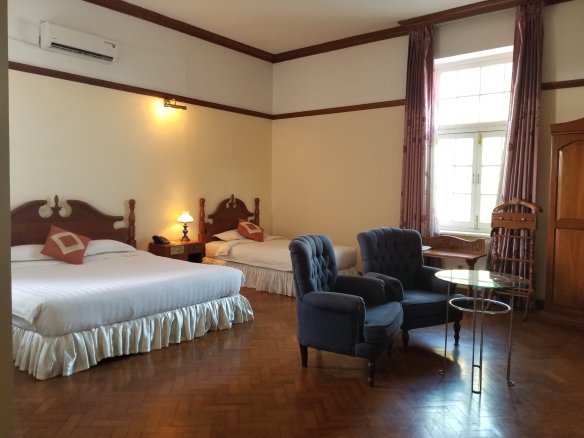
The taxi drops a nitrogen-weary mermaid at her hotel in Yangon, and it’s like night-and-day to the Bates-esque experience of the previous night. I check into the Yuzana Garden Hotel (which I’ve booked online for maybe $5 more than what I’ve just paid in Kawthaung) and feel like I’m walking into a renovated palace with its 15-foot ceilings and wood and marble finishes.

N.B. For this trip, my hotels average ~$25USD per night, and this one (very much in the price range, thanks to Agoda) is by far the snazziest!

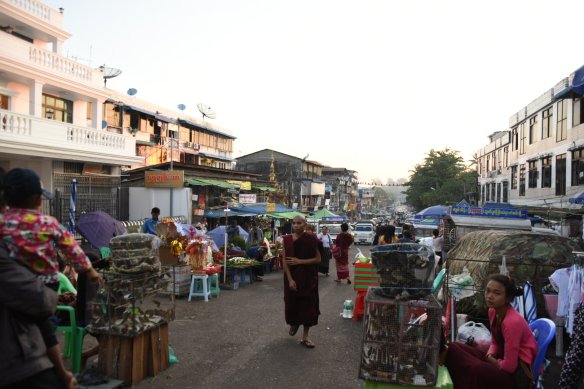
After getting settled, we head out on foot to wander the streets of Yangon, not aimlessly, but since it’s later than anticipated, the anticipated market is closing for the evening so we walk past one of the city’s “Christmas in Yangon” stages that have been set up for tonight’s celebrations.

I say a private Happy Birthday Dad and we walk on, then jump in a cab and arrive in Chinatown for a beer and Yangonese BBQ on 19th Street, which, I’m told, has become one of the only decent places for young people to hang out together in this city. And so it seems: the street is bustling, as millennials (plus only a v small smattering of tourists) line the restaurants, drinking beer served up by the beer girls from Myanmar and Chang, and chatting up a storm over BBQ. You fill a basket with skewers of every imaginable thing, from chicken feet to quail eggs, squid to sausages, and hand the basket to the BBQ guy who sends it to the kitchen to cook, and the meal is delivered to your table with rice and a fantastic dipping sauce.

We don’t have much of an agenda tonight so we wander the streets of Chinatown and beyond, eventually making it back to the area where Christmas is in full swing, and we arrive at the same stage we were at earlier to catch local renditions of Feliz Navidad and Santa Claus is Coming to Town. Is he? I wonder… We’ve been talking tonight of the monumental changes taking place in this country since the Regime was ousted only 3 years ago. It’s like a new lease on life for many of these young people here, and the significance that we’re on the street after 9pm watching a modern-clad local songstress belting out Western Christmas music is not lost on anyone in the massive crowd, myself included.

Next morning, we head out before dawn to Shwedagon Pagoda. This is the most sacred Buddhist site in all of Myanmar, and as such attracts devotees and tourists from across the globe. We arrive well before 6am, and while there are no tourists here at this dark hour, there are streams of worshippers at every possible corner of the place.

There are no words that can describe it here: the air smells of jasmine and incense and wood smoke. My ears are buzzing with the sounds of chanting and individual mantras, all in languages I cannot decipher, but that join together in a soundscape that melds with the nag champa. The rising sun turns the mesmerising 100 metre-tall gold leafed stupa first pink, then a vibrant, lustrous gold that seems to drink in the morning’s rays.

It’s said that 8 hairs of Gautama Buddha are encased in this stupa, archaeologists estimating that it was erected c. the 7th century, though legend says it was built 2000 years before that. And while I’m not a practising Buddhist, one cannot help but be drawn into the story and embraced by the surroundings here.

As we exit the temple, a market of sorts is set up, selling materials for prayer offerings and myriad other goods from refrigerator magnets to local handicrafts to idols. What gives me pause is the wicker cage full of songbirds that are on offer: you purchase one in order to set it free, symbolic of releasing one’s attachments and so forth. It hurts my head and heart to think about the contradictions. And my guide agrees with my disdain: they’ve found a way to usurp the teachings for their own profit. Prophets, they are not…and my skepticism of organised religion continues.

We continue on to brekkie, more wandering, a ride on the railway, the bus, and a local ferry across the Yangon River to Dalah, just to make sure we’ve hit all modes of transport here. We visit another pagoda and admire their reclining Buddha, its soles telling Gautama’s horoscope. And of course, lunch at the Rangoon Tea Shop, rounding out the musts for the visit here.

My impression? There’s not a lot to do in Yangon, but Shwedagon is literally awe-some. The food is excellent, and I note the Indian, Chinese and Western influences in nearly everything we’ve managed to inhale these past 24 hours. I find it amusing that at every meal so far I’ve been asked, you can eat spicy food? or told, very concerned, that’s spicy. Yes, I reply, donning my chopsticks and smiling.

Bonus: I’ve also managed to find custard apples, an Asian fruit I’ve only ever seen before in India. Now, onwards to the next (next) part of the journey that begins with an unexpected jolt.


Inle: They say what doesn’t kill you makes for a good story after-the-fact, right? Just so, because as I was worried about flying Myanmar National Airlines, I was not worried at all about the taxi I’d take from little Heho airport to Inle.

The air here is fresher than Yangon, and a smoky evening mist is settling. I get in the mini-van and we start driving down the steep 2-lane road that winds up and over the small mountains that surround Inle Lake. The views are stunning in the waning light. About 15 minutes in, my driver starts slowing down and veering towards the edge of the road. There’s a nice scenic overlook where others are stopped, so I think he’s slowing to give me a photo opp.

Problem is, he doesn’t stop.

Before I can figure out what just happened, we’ve crashed into the white and red safety pylon thing that separates us from the 100+ metre drop-off, which at this point is directly in front of the vehicle. The driver has either passed out or fallen asleep at the wheel, and the jolt wakes him enough to look back at me with these hauntingly glassy eyes (and for me to ask are you okay?). I think I’m in a bit of shock, because it takes a moment before I realise I must get out and get help. Immediately.

My mind is racing but I am not moving. I can’t even imagine what would have happened if we were going any faster. It’s almost sunset. I’m in Burma. The absolute only place I know I DO NOT WANT TO GO on this trip is a Burmese hospital. Will the post hold? I just read a book about the opium trade. I wonder if he’s on opium. Get. Out. Of. The. Van.

I drag myself out of my own head and get out of the vehicle.

The post is holding back the van; it’s bent over, and the vehicle does not look good: there is a massive dent in the front bumper in which the post is now embedded. Time feels somehow warped, slow but too fast, and as I put my hand out to flag down a passing taxi, he is already pulled over. He gets out, checks the car, checks the guy, points to his cab and says, Get in. Get in now.

It takes me a moment to remember to grab my bag from the back, but we get it loaded and there is a very nice and very concerned older Swiss couple in the back seat. Glad to be safe, we continue onward and the taxi driver calls the authorities.

Shaken, but not deterred, I profusely thank the driver and the lovely Swiss duo for rescuing me and getting me to my hotel in one piece. Still, part of my brain is also wondering what to do about the glassy-eyed driver.

The rest of the evening goes better: this hotel is lovely, and a hanging garden full of orchids and greenery lines the pathway to my room.

Armed only with a guidebook and a hotel reservation (and Burmese fisherman’s pants), I know how to say hello and thank you, and I’ve got no idea what to do first here, but this is my launch pad for the next few days as I explore the famed Inle Lake.

I silently wish my co-adventuring Calvin were here to continue the journey with me. I make a cup of tea and try to shake off the recent events and doubts.


Demain est un autre jour…the lake awaits.


Read more: [Part I] [Part II] [Part III] [Part V]